Most homeowners in North Georgia assume Georgia has a dedicated roofing license. It does not. That single misconception leads thousands of homeowners every year to hire unqualified contractors, skip permits, and end up with failed insurance claims or unsafe roofs. Knowing how Georgia’s licensing framework actually works gives you real power before you sign any contract. This guide breaks down the licensing rules, contractor responsibilities, storm repair risks, and permit requirements you need to protect your home and your investment.
Table of Contents
- Understanding roofing contractor licensing in Georgia
- Key responsibilities of licensed roofing contractors
- Why local expertise and licensed status matter for storm repairs
- Navigating legal and permit requirements for roof repairs
- Our take: avoid shortcuts — licensed contractors are your safety net
- Connect with North Georgia’s most trusted roofing contractors
- Frequently asked questions
Key Takeaways
| Point | Details |
|---|---|
| No standalone roofing license | Georgia requires general contractor licensing for roofing jobs over $2,500—not a dedicated roofing license. |
| Licensed contractors ensure safety | Licensed roofers follow code, obtain permits, and coordinate insurance, reducing risks for homeowners. |
| Local expertise matters | North Georgia contractors understand storm damage, local codes, and long-term accountability compared to outsiders. |
| Permits required for major repairs | Any roof replacement or repairs over 25% area or $2,500 require permits and licensed professionals. |
| Avoid storm chaser fraud | Choosing local, licensed contractors protects against fraud and ensures code-compliant restoration after storms. |
Understanding roofing contractor licensing in Georgia
Georgia’s approach to roofing licenses is different from what most people expect. The state does not issue a standalone roofing license. Instead, roofing falls under general residential or general contractor licenses for any project valued over $2,500. That threshold matters. A simple patch repair under $2,500 might not legally require a license, but a full replacement or major storm repair almost always will.
There are two main licensing paths in Georgia. The Residential Basic Contractor license covers single-family homes and smaller residential projects. The General Contractor license covers larger commercial and residential work. Both require passing state exams, submitting proof of insurance, and maintaining proper registration. You can verify any contractor’s license status quickly at sos.ga.gov, the Georgia Secretary of State’s website. This takes about two minutes and could save you thousands.
Beyond state licensing, look for manufacturer certifications from companies like GAF and CertainTeed. These certifications are not just marketing badges. They signal that the contractor has received product-specific training and can offer extended material warranties that unlicensed or non-certified installers simply cannot provide. A GAF Master Elite contractor, for example, can offer a 50-year warranty on certain shingle systems. A standard contractor cannot.
Here is a comparison of what different licensing levels mean for your project:
| Project type | License required | Permit required | Notes |
|---|---|---|---|
| Minor repair under $2,500 | No state license required | Possibly not required | Local codes vary |
| Residential repair over $2,500 | Residential Basic or General | Yes | Must verify at sos.ga.gov |
| Full roof replacement | Residential Basic or General | Yes | Always required |
| Commercial project over $100,000 | General Contractor license | Yes | Higher threshold applies |
Key things to check before hiring any roofing contractor in North Georgia:
- ✅ License verified on sos.ga.gov
- ✅ General liability insurance of at least $500,000
- ✅ Workers’ compensation coverage
- ✅ Manufacturer certification (GAF, CertainTeed, or similar)
- ✅ Local physical address and verifiable references
- ✅ Permit pulled before work starts
Understanding residential roofing requirements in detail helps you ask the right questions from day one. Do not wait until after a storm to start this research.
Key responsibilities of licensed roofing contractors
Once you know what to look for in contractor credentials, it is vital to understand the responsibilities that separate licensed pros from risky alternatives.
A licensed contractor is not just someone with a piece of paper. They carry legal obligations that protect you at every stage of the project. Licensed contractors must pass exams, carry a minimum of $500,000 in general liability insurance, maintain bonding for certain project types, and pull local building permits for roof replacements, major repairs exceeding 25% of the roof area, and storm damage restoration. If a contractor tries to skip the permit step, that is a serious red flag.
Their responsibilities also extend into the technical details of the installation itself. Inspecting damage, pulling permits, coordinating with insurance companies for storm claims, and installing roofs per local International Residential Code (IRC) or International Building Code (IBC) standards are all core contractor duties. This means properly removing old materials, installing underlayment, flashing around chimneys and valleys, and using the right fastening patterns for North Georgia’s wind loads.
Here is what a professional, code-compliant roofing process looks like from start to finish:
- Initial inspection and damage documentation with photos and written assessment
- Insurance claim coordination, including submitting estimates and negotiating with adjusters
- Permit application and approval from the local county or city building department
- Tear-off of existing materials following IRC layer limits
- Proper underlayment installation per manufacturer and code specifications
- Flashing, drip edge, and ventilation installed to code
- Shingle or roofing material installation using manufacturer-approved methods
- Final building inspection and certificate of completion
- Cleanup and material disposal with no debris left behind
- Warranty documentation provided to the homeowner in writing
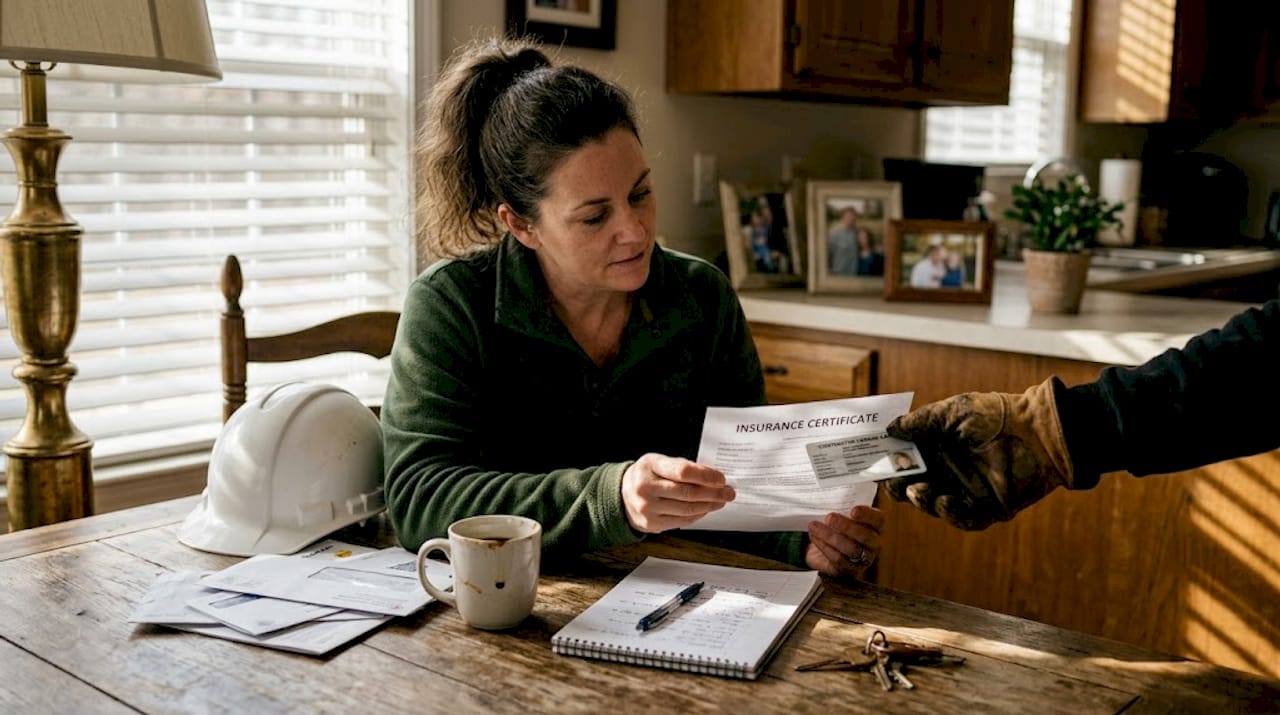
Pro Tip: Always request a physical copy of the contractor’s license number, insurance certificate, and bond information before work begins. Do not accept verbal assurances. A reputable contractor will have these documents ready within minutes.
The difference between a licensed and unlicensed job often shows up months later. Failed inspections, voided manufacturer warranties, and denied insurance claims are common outcomes when corners are cut. If you are navigating roof repair step-by-step, understanding each phase helps you hold your contractor accountable throughout.
When dealing with roof insurance claims, a licensed contractor who understands the documentation requirements is invaluable. Insurance companies look for code-compliant work and proper permits. Without those, your claim can be partially or fully denied even if the damage is legitimate.
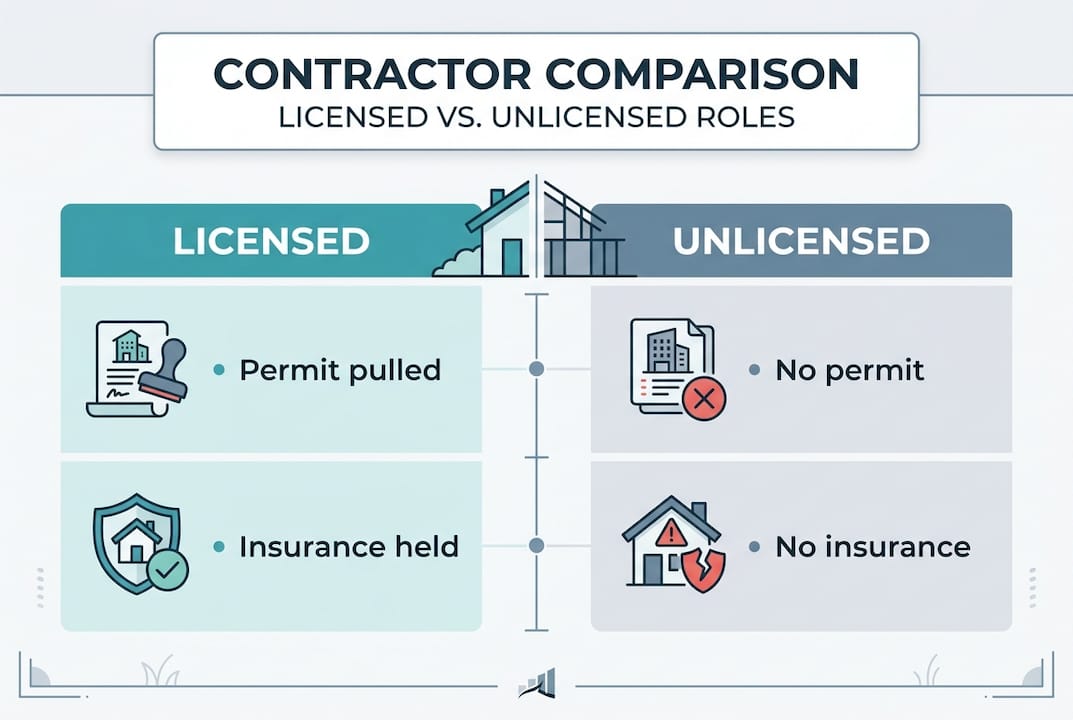
| Contractor type | Permit pulled | Insurance carried | Warranty provided | Accountability |
|---|---|---|---|---|
| Licensed and insured | Yes | Yes (min. $500k) | Manufacturer + labor | State board enforcement |
| Unlicensed | Rarely | Often none | None | None |
| Out-of-state storm chaser | Often no | Unknown | Rarely | Difficult or impossible |
Knowing these distinctions helps you make a clear, confident decision. Especially when dealing with Georgia storm repair insurance situations, having the right contractor from the start prevents costly mistakes.
Why local expertise and licensed status matter for storm repairs
Storm damage is where licensing becomes critical. Let’s compare how local experts and storm chasers impact your roof and peace of mind.
North Georgia sees regular severe weather. Hail storms, straight-line winds, and sudden heavy rain are seasonal realities across Cherokee, Paulding, Bartow, and surrounding counties. After every major storm event, out-of-state contractors flood the area. These “storm chasers” often arrive within days, offering fast quotes and promises of fully covered repairs. The problem is that many operate without a Georgia license, local knowledge, or any intention of being around if problems arise.
Licensed contractors in North Georgia document storm damage thoroughly for insurance, perform emergency tarping to prevent further water intrusion, and ensure every restoration step is code-compliant, even when the work is fully funded by insurance. Permits are always required for full replacements, regardless of who pays the bill.
“A licensed local contractor is your first and best defense against post-storm fraud. They know the local codes, they pull the right permits, and they will still be here when you need them in five years.”
Red flags to watch for after any storm event:
- 🚩 Contractor has no local address or physical office
- 🚩 Offers to waive your insurance deductible (this is illegal in Georgia)
- 🚩 Refuses to pull a permit or claims it is unnecessary
- 🚩 Provides only a verbal quote with no written contract
- 🚩 Cannot provide license number or insurance certificate on request
- 🚩 Pressures you to sign immediately before you can compare quotes
Here is a direct comparison between hiring locally and hiring a storm chaser:
| Factor | Local licensed contractor | Out-of-state storm chaser |
|---|---|---|
| Georgia license | Verified | Often absent |
| Local code knowledge | Strong | Limited or none |
| Permit compliance | Standard practice | Frequently skipped |
| Insurance coordination | Experienced | Unreliable |
| Long-term accountability | Yes | Rarely |
| Warranty support | Manufacturer-backed | Often voided |
Working with a 5-star local roofing company means you have someone accountable in your community. They have a reputation to protect. They are not going to disappear after cashing your check.
Beyond fraud prevention, local contractors also understand the specific installation standards that apply in North Georgia. Wind uplift requirements, for example, vary by county. A contractor who regularly works in the area understands exactly what the local building inspector expects and installs accordingly. The roof replacement benefits of working with licensed local professionals extend well beyond the initial repair. Proper installation protects your home for decades.
Navigating legal and permit requirements for roof repairs
With local and licensed expertise outlined, your final responsibility is to navigate legal and permit rules efficiently.
Permit requirements in Georgia are not optional. For any roof replacement or repair that exceeds 25% of the total roof area or crosses the $2,500 value threshold, a permit is required. Local jurisdictions in North Georgia, including those in Paulding, Cherokee, and Bartow counties, follow this standard closely. Some municipalities have even stricter local amendments.
Here is a step-by-step breakdown of how permit requirements work in practice:
- Assess the scope of work. If more than 25% of your roof is being replaced or repaired, a permit is mandatory.
- Confirm local requirements. Contact your county building department or ask your contractor to verify the specific rules for your address.
- Contractor submits permit application. This includes plans, material specs, and contractor license information.
- Permit is approved and posted. Work cannot legally begin until the permit is posted at the job site.
- Work is completed per approved plans. Changes to scope require an updated permit.
- Final inspection is scheduled. A building inspector verifies code compliance before the permit is closed.
Pro Tip: Ask your contractor for the permit number before any work begins. You can verify this number with your local building department to confirm it is real and active. This simple step protects you from unpermitted work that could cause serious problems when you sell your home.
Full tear-off vs. overlay limits also matter here. The IRC limits most residential roofs to two layers of shingles. If your home already has two layers, the contractor must perform a full tear-off before installing new materials. Skipping this step is a code violation, and it voids most manufacturer warranties.
There is also an owner-builder exemption in Georgia. Homeowners who own and occupy their primary residence can, in some cases, act as their own general contractor. However, this does not eliminate permit requirements. You still need to pull permits, pass inspections, and follow all local codes. For anything beyond basic cosmetic repairs, this route carries significant risk.
Georgia also enforces strict penalties under O.C.G.A. §43-41-17 for unlicensed contracting. Fines, stop-work orders, and legal liability are all possible outcomes. Post-storm fraud is a persistent problem in the state, and the licensing board actively investigates complaints. Hiring a licensed contractor is the clearest way to stay on the right side of these regulations.
For commercial properties, the thresholds are higher. Projects exceeding $100,000 require a full General Contractor license rather than a Residential Basic license. If you manage commercial property in North Georgia, review the commercial roofing checklist for a clear picture of what compliance looks like at scale. In areas near Georgia’s wildland-urban interface, Class A fire-rated materials are also often required, adding another layer of compliance that only experienced local contractors fully understand.
Our take: avoid shortcuts — licensed contractors are your safety net
After years of working across North Georgia, one thing stands out clearly. The homeowners who regret their roofing decisions almost always made the same mistake: they chose the cheapest quote without verifying credentials.
We have seen unlicensed work cause real harm. Not just leaks or cosmetic issues, but failed insurance claims, liens placed on properties by unpaid subcontractors, and code violations discovered during home sales. These are not rare edge cases. They happen regularly when homeowners prioritize speed or price over accountability.
The uncomfortable truth is that an unlicensed contractor is not just a legal risk to themselves. They become your legal risk the moment work starts on your property. If a worker is injured without proper workers’ compensation coverage, the liability can fall on you as the homeowner.
What we recommend is simple. Verify every contractor on sos.ga.gov before you agree to anything. Ask for insurance certificates dated within the last year. Confirm that permits will be pulled before any work begins. And check references, not just star ratings. A trusted local roofing company will welcome these questions. A contractor who pushes back on any of them is telling you exactly what you need to know.
Connect with North Georgia’s most trusted roofing contractors
At Infinity Roofing GA, we are licensed, insured, and ready to handle every stage of your roofing project with the professionalism and accountability your home deserves.

Whether you need a complete walkthrough of the storm repair process, immediate professional storm damage repair, or reliable gutter cleaning and repair to keep water moving away from your home, our team is here to help. We serve homeowners across Dallas, Marietta, Canton, Cartersville, and throughout North Georgia. Same-day responses, honest estimates, and 5-star service are what we deliver on every job. Reach out today and let us protect your home the right way.
Frequently asked questions
Is there a roofing license in Georgia?
Georgia does not issue a dedicated roofing license; roof work falls under Residential Basic or General Contractor licenses for jobs over $2,500.
Do I need a permit for roof repairs in North Georgia?
Permits are required for roof replacements or repairs exceeding 25% of the roof area or $2,500 in value, with no exceptions for insurance-funded work.
How do licensed contractors protect homeowners during storm damage repairs?
Licensed contractors document storm damage thoroughly for insurance, perform emergency tarping, and ensure all restoration work is code-compliant and properly permitted.
What are the risks of hiring an unlicensed or out-of-state contractor?
Unlicensed contractors often skip permits, provide vague contracts, and carry no insurance, leaving homeowners exposed to legal liability, code violations, and denied insurance claims.
Can I repair my own roof in Georgia?
Owner-builders can apply for permits but must follow all local code and overlay limits; most major repairs still benefit significantly from a licensed contractor’s expertise and warranty backing.