Storms across North Georgia have been hitting harder and more frequently, leaving homeowners with roof damage that demands a fast decision. US roof claims hit $31B in 2024, a 30% increase since 2022 driven by more severe weather and rising material costs. That number tells a clear story: the roof over your head is under more pressure than ever, and choosing between repair and replacement has real financial consequences. This guide gives you the clear, honest information you need to make the right call for your home and your budget.
Table of Contents
- How roof age and storm damage affect your options
- Repair vs. replacement: Weighing the pros and cons
- How costs and insurance factor into your decision
- Making the right choice for your home
- Our honest take: Don’t let urgency rush your roof decision
- Explore professional solutions for your North Georgia roof
- Frequently asked questions
Key Takeaways
| Point | Details |
|---|---|
| Assess roof age first | Your roof’s age is the most important factor in the repair or replace decision. |
| Storms accelerate wear | Hail and storms in North Georgia mean roof lifespan may be shorter than manufacturer estimates. |
| Repair extends but doesn’t reset | Repairs add years to a roof but can’t make an older roof new again. |
| Insurance can shape your choice | Higher claims and inflation affect whether insurance covers repairs or replacement. |
| Consult local experts | Expert advice is crucial for complicated damage or costly decisions in storm-prone areas. |
How roof age and storm damage affect your options
Let’s start by looking at the critical factors, roof age and storm damage, that shape your options.
Your roof’s age is the single most important variable in the repair versus replacement conversation. Not every damaged roof needs full replacement, but not every damaged roof can be saved with a patch either. Understanding where your roof falls on the lifespan spectrum is the foundation of a sound decision.
Asphalt shingles in North Georgia are the most common roofing material you’ll find in our area, and they come with a defined lifespan. According to current industry data, asphalt shingles last 20 to 25 years under normal conditions, though roofs in hail-prone regions like North Georgia can see that window shrink to as little as 15 years. Localized repairs can add 5 to 15 years to a roof’s service life, but only when the underlying structure is still solid.
North Georgia’s climate is particularly rough on roofing materials. We deal with summer hailstorms, ice in winter, heavy spring rain, and strong winds from passing storm systems. Each weather event causes cumulative wear, even when individual storms don’t cause immediately visible damage. Hail, in particular, creates micro-fractures in shingle granules that accelerate deterioration over time, often leading to leaks and structural issues years after the actual storm.
Here’s a quick reference to help you assess your situation:
- 🏠 Roof under 10 years old with localized damage: Repair is likely the right move.
- 🏠 Roof between 10 and 18 years with storm damage: Evaluate repair scope carefully. Multiple damaged sections may favor replacement.
- 🏠 Roof over 20 years old with any significant damage: Full replacement is almost always the better investment.
- 🏠 Missing or curling shingles across large areas: A strong indicator of system-wide failure, not isolated damage.
- 🏠 Water stains on ceilings or walls: Signals active leaks that may have compromised the decking underneath.
- 🏠 Granule loss visible in gutters: Shingles are breaking down and losing protective coating.
If you are unsure where your roof stands, our roof restoration guide walks through each condition in detail. You can also take advantage of same-day roof estimates if you need answers quickly after a storm.
The bottom line here is simple. Age and storm history together tell the real story of your roof’s condition. A 12-year-old roof with minor hail damage is a very different situation from a 22-year-old roof with the same damage. Treating them the same way leads to costly mistakes.
Repair vs. replacement: Weighing the pros and cons
Now that we’ve covered the basics, let’s directly compare repair and replacement options.
Both choices have genuine advantages, and neither is automatically better. The right answer depends on your specific roof, your budget, and your long-term plans for the home.
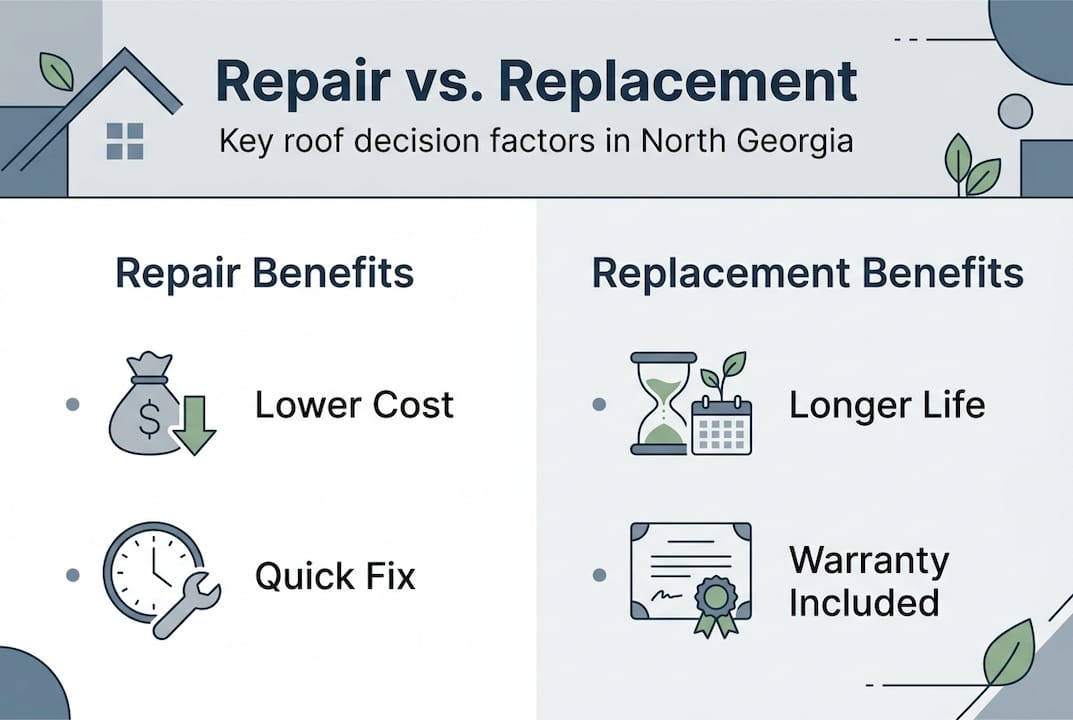
| Factor | Repair | Replacement |
|---|---|---|
| Upfront cost | Lower ($300 to $1,500 typical) | Higher ($8,000 to $18,000+ typical) |
| Long-term value | Shorter extension of roof life | Full lifespan reset (20 to 25 years) |
| Best for | Young roofs, localized damage | Aging roofs, widespread damage |
| Insurance payout | Partial coverage possible | Full replacement cost often covered |
| Time to complete | Hours to 1 to 2 days | 1 to 3 days typically |
| Risk of repeat issues | Higher on older roofs | Low with quality materials |
Advantages of repair:
Repair is the right answer when damage is genuinely limited to one section or a small portion of the roof. It protects you from immediate water intrusion at a fraction of full replacement cost. For a newer roof, repair is almost always the smarter financial decision since you still have significant life left in the system. A good repair by a licensed contractor can add 5 to 15 years to a healthy roof’s service life, which is real value.
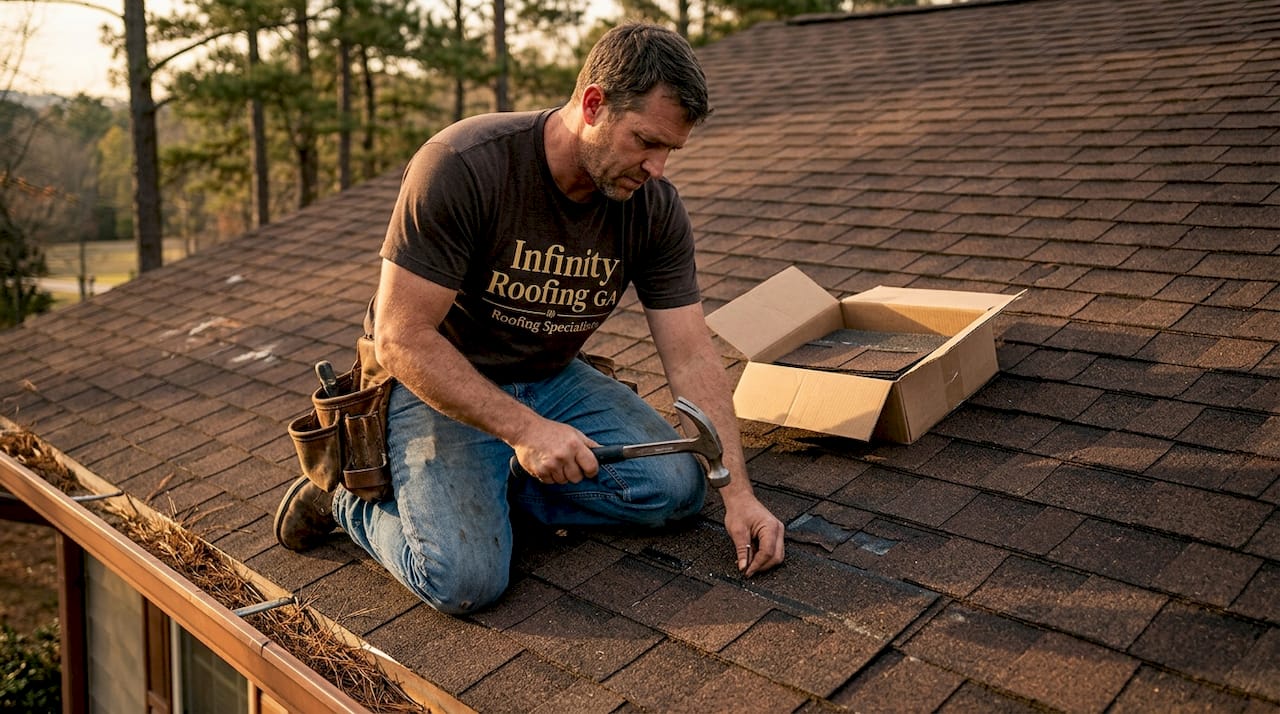
Risks of repair:
The risk with repair is that it can become a trap on older roofs. You pay $800 for a patch today, then $1,200 for another repair two years from now, and again two years after that. By the time you add it up, you’ve spent close to what replacement would have cost, and your roof is still aging out. This is especially true in hail-prone areas where roofs may require replacement more frequently, as storm events that appear minor can compromise shingle integrity across the entire surface.
Advantages of full replacement:
Replacement gives you a clean start. New shingles, new underlayment, a warranty, and the opportunity to upgrade materials if your current roof was underbuilt for North Georgia weather. It also eliminates the guessing game about what’s lurking under a patched surface. Many homeowners find that replacement, when covered by insurance, actually costs them very little out of pocket.
Learn more about roof replacement advantages specific to North Georgia homes, or review storm roof repair steps if you’re leaning toward addressing specific storm damage.
Pro Tip: Before committing to repair, ask your contractor to inspect the decking underneath the damaged area. Hidden rot or moisture damage in the wood decking dramatically changes the cost equation and may make replacement the smarter choice even on a younger roof.
How costs and insurance factor into your decision
Let’s explore the financial dimension, what costs, claims, and insurance trends mean for your choice.
Roofing decisions are also financial decisions. Ignoring the cost and insurance side of this equation can leave significant money on the table or lead you into a choice that strains your budget unnecessarily.
Typical costs in North Georgia:
| Service | Low estimate | High estimate |
|---|---|---|
| Minor repair (1 to 2 shingles) | $150 | $400 |
| Moderate repair (section damage) | $500 | $1,500 |
| Partial reroof | $2,500 | $5,000 |
| Full replacement (1,500 sq ft home) | $8,000 | $14,000 |
| Full replacement (2,500 sq ft home) | $12,000 | $20,000+ |
These figures reflect 2026 pricing in the North Georgia market. Material costs have risen considerably alongside the broader trend of roof claims totaling $31B nationally in 2024, a 30% increase since 2022. Inflation has affected shingles, underlayment, fasteners, and labor, which is why getting a current estimate is so important rather than relying on what your neighbor paid two years ago.
How insurance works in your favor:
Most homeowner insurance policies cover storm-related roof damage, including hail, wind, and falling debris. If your roof suffered damage in a storm, you may be entitled to a full replacement at minimal out-of-pocket cost. The key is knowing how to document, file, and advocate for your claim.
Here’s how to approach the insurance process:
- Document everything immediately. Take photos and video of all visible damage, including interior water stains, from multiple angles before any cleanup.
- Avoid emergency repairs that could affect your claim. Temporary tarping is fine, but do not let anyone start permanent work before the adjuster visits.
- Call your insurance company promptly. Most policies require timely reporting of damage. Delays can complicate your claim.
- Request a licensed contractor inspection before the adjuster arrives. A professional assessment gives you supporting documentation and helps identify damage that non-experts might miss.
- Review the adjuster’s report carefully. Insurance adjusters can overlook items. Having a contractor who understands the claims process review the report can increase your payout.
Pro Tip: At Infinity Roofing GA, we assist homeowners through the full insurance claims process at no extra charge. Our team knows what adjusters look for and how to document damage properly to help you get maximum coverage.
For a complete walkthrough, visit our guide on insurance claims for roof repairs or read our roof insurance guide specifically designed for Georgia homeowners.
Making the right choice for your home
With all factors considered, here’s how to confidently move forward with your roof.
The repair versus replacement decision is never one-size-fits-all. But there are reliable patterns you can use to guide your thinking before you ever talk to a contractor.
Ask yourself these questions first:
- How old is the roof? If it’s past 20 years, replacement deserves serious consideration regardless of damage scope.
- How much of the roof surface is affected? Damage covering more than 30% of the roof almost always points toward replacement as the more cost-effective option.
- Has this roof been repaired before? Multiple prior repairs are a sign the system is failing, not just having a bad season.
- What does your insurance cover? If your policy provides full replacement cost coverage, the financial argument for repair weakens considerably.
- Do you plan to sell the home in the next few years? A new roof significantly increases resale value and removes a major inspection concern for buyers.
- Are there any interior leaks or signs of structural damage? These point to problems that surface repairs cannot fix.
Key local factors for North Georgia homeowners:
North Georgia sits in a region with above-average hail frequency, significant wind events, and a wide temperature range between seasons. These conditions accelerate shingle wear faster than in milder climates. Local building codes also have specific requirements for roofing materials and installation practices, which is why working with a contractor who knows the area matters. An out-of-state or unlicensed contractor may not be current on Georgia-specific requirements.
Insurance rules in Georgia have also evolved in recent years. Some insurers are adjusting coverage terms and deductibles for weather-related claims, making it even more important to understand your policy before making a repair or replacement decision.
“A qualified local contractor can give you an honest assessment of your roof’s condition and help you understand your insurance options. Don’t make a permanent financial decision based on a guess.”
If you’ve experienced storm damage and need to start with a reliable repair process, our detailed DIY storm roof repair guide covers what you can safely handle and when to call in a professional. For most North Georgia homeowners, especially after significant storms, a professional inspection is the safest first step.
Our honest take: Don’t let urgency rush your roof decision
Before wrapping up, here’s our candid view on how North Georgia homeowners can avoid costly mistakes.
After years of working with homeowners across Paulding County, Cherokee County, Bartow County, and the broader North Georgia region, we’ve seen the same costly pattern repeat itself. A storm rolls through, a homeowner sees damage and feels pressure to act immediately, and they make a hasty decision they regret later.
Sometimes that means paying for a repair that buys six months of relief but ignores a roof that should have been replaced entirely. Other times it means agreeing to a full replacement that wasn’t necessary, sold by a contractor who showed up the day after the storm with a high-pressure pitch.
The reality is this: urgency is real after a storm, but it rarely demands a same-day decision about your entire roof. Water intrusion needs immediate attention, yes. But the broader question of repair versus replacement benefits enormously from a calm, thorough assessment.
We’ve seen homeowners turn down insurance replacement coverage because a contractor told them a repair would “take care of it.” Two years later, they’re dealing with the same problems and now the insurance window has closed. That’s an expensive mistake that a proper evaluation would have prevented.
We believe that the homeowners who get the best outcomes are the ones who slow down just enough to ask the right questions, get a second opinion if something doesn’t feel right, and work with a contractor who will tell them the truth even when the truth is “your roof is fine, you just need a minor repair.”
Our goal is never to sell you more than you need. But we also won’t tell you a repair will hold when your roof is telling us something different. That honesty is what builds lasting trust with our neighbors across North Georgia. Explore the full case for why replacement sometimes wins even when repair seems cheaper through our breakdown of roof replacement pros for North Georgia conditions.
Explore professional solutions for your North Georgia roof
If you’re ready for trusted support, here’s where to get help and information tailored to North Georgia homeowners.
At Infinity Roofing GA, we’ve been helping homeowners in Dallas, GA and across North Georgia since 2018 with honest evaluations, quality repairs, and full replacements backed by premium materials. Whether you’re dealing with fresh storm damage roof repair needs or trying to decide if it’s time to replace an aging system, we’re here to give you a clear-eyed assessment with no pressure.

We also offer comprehensive insurance claim support, helping you document damage, communicate with adjusters, and secure maximum coverage. Our resources, including our guide on how to repair storm-damaged roof sections and our overview of roof replacement benefits, are designed to help you understand your options before you commit. Contact us today for a same-day estimate. We respond fast, work clean, and stand behind every job we do.
Frequently asked questions
How long can a roof last after repairs?
Quality repairs by a licensed contractor can add 5 to 15 years to a roof’s lifespan, particularly when the underlying structure is still in solid condition and the repaired area is limited. The results will be shorter on roofs already showing age-related deterioration across multiple sections.
What signs mean I should replace my roof rather than repair it?
Widespread curling or missing shingles, multiple active leaks, or a roof that has exceeded its 20 to 25 year expected lifespan are all strong indicators that replacement is the more reliable and cost-effective path. In North Georgia’s hail-prone environment, that lifespan can be closer to 15 years.
Does home insurance cover roof replacement due to storms?
Most standard homeowner policies do cover storm-related roof damage, but rising claim volumes and inflation have prompted some insurers to adjust coverage terms and increase deductibles. Reviewing your policy carefully before filing is always a smart first step.
Can I repair storm damage myself?
Minor cosmetic issues like replacing one or two shingles are within reach for a confident DIYer, but widespread storm damage, active leaks, or any damage involving the roof deck or flashing requires a licensed professional to assess and repair correctly. Improper repairs can void warranties and complicate future insurance claims.