A big storm rolls through North Georgia, shingles land in your yard, and a neighbor suggests you just slap on a few new shingles and call it done. That advice sounds simple and cheap, but it can cost you far more down the road. Roof replacement means stripping everything down to the deck and starting fresh with a code-compliant system, not just covering damage with a new layer. This guide walks you through what full replacement really involves, what it costs, how insurance works, and how to make smart choices after a storm hits your North Georgia home.
Table of Contents
- Understanding roof replacement: what it is and why it matters
- The roof replacement process: step by step for storm damage
- Cost breakdown: roof replacement in North Georgia
- Navigating insurance claims for storm-damaged roofs
- Choosing materials and the right roofer: North Georgia considerations
- The truth about roof replacement after storms: what most guides miss
- How Infinity Roofing GA can help you with stress-free roof replacement
- Frequently asked questions
Key Takeaways
| Point | Details |
|---|---|
| Full replacement defined | A true replacement removes all roofing down to the deck and rebuilds according to codes. |
| Storm damage triggers claims | If over 25% of your roof is damaged, insurance will often support full replacement. |
| Know your roof costs | In North Georgia, asphalt shingle roof replacements average $9,000–$16,000. |
| Claim process tips | Document damage, act fast, and team with a trusted local roofer for insurance success. |
| Material and contractor matter | Choose impact-resistant materials and local, licensed pros for lasting peace of mind. |
Understanding roof replacement: what it is and why it matters
Knowing the basics helps you make confident decisions. Let’s break down what actually happens when you replace a roof.
A true roof replacement is exactly what it sounds like. Every layer of old roofing material comes off, workers inspect the decking underneath, and a completely new roofing system goes on from the bottom up. This is fundamentally different from a repair, which patches specific damaged spots, or an overlay, which simply lays new shingles on top of old ones.
Here’s why that distinction matters so much:
- Overlays hide problems. When workers add a layer on top of existing shingles, they can’t see rotted decking, hidden moisture damage, or compromised flashing. Those problems keep growing underneath.
- Building codes restrict overlays. Most local jurisdictions in North Georgia only permit one overlay layer. Once that layer is already there, your only legal option is a full replacement.
- Insurance may require replacement. If your current roof has storm damage affecting more than 25% of its surface, most insurance policies treat it as a total loss requiring full replacement, not a patch job.
- Repairs on older roofs rarely hold. If your asphalt shingles are 20 years old and a storm hits, a repair buys you maybe a year or two before the rest of the aging system starts failing around it.
The bottom line: Overlays and repairs have their place for minor, isolated damage on roofs in good shape. For storm-hit roofs in North Georgia, full replacement is usually the safer, smarter, and often code-required path. Learn more about the benefits of roof replacement specific to homes in our region.
North Georgia’s building codes vary by county, but all require that replacements meet current International Residential Code (IRC) standards for underlayment, ventilation, and flashing. Working with a licensed local contractor means your replacement passes inspection without delays or costly do-overs.
The roof replacement process: step by step for storm damage
With the core definition clear, let’s walk through what actually happens when you start a replacement project.
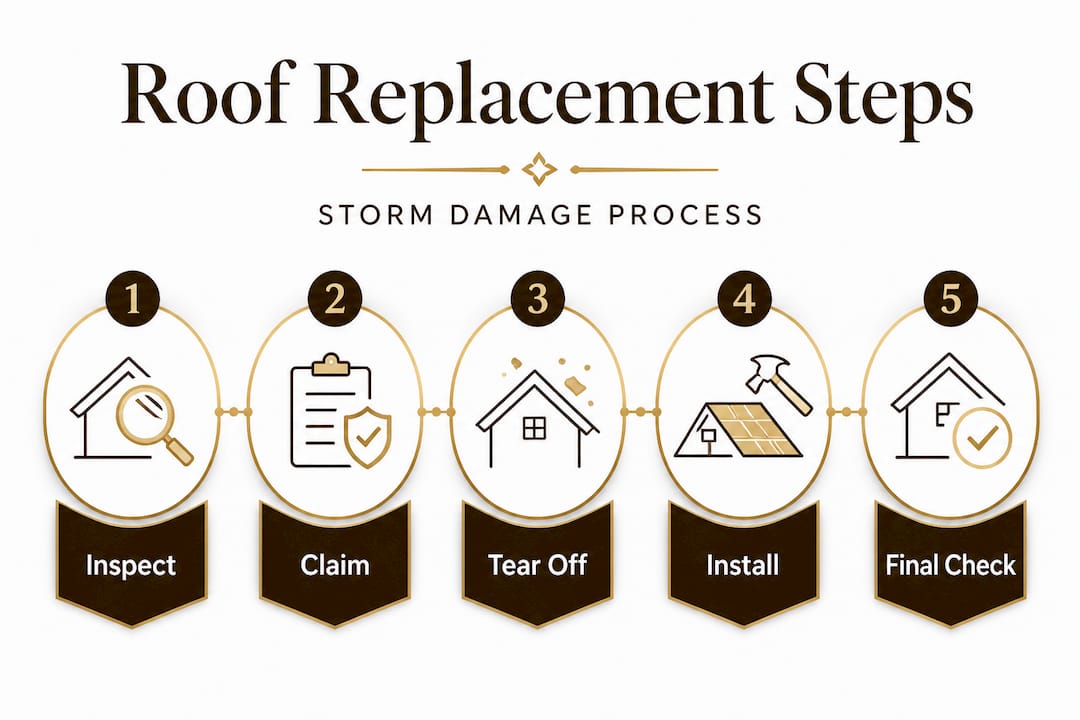
The process is more structured than most homeowners expect. There are no shortcuts if you want a roof that lasts 25 to 50 years. Here’s what a professional, code-compliant replacement looks like from start to finish:
- Inspect and document damage. Before anything gets removed, a licensed inspector photographs every damaged area. This documentation is critical for your insurance claim.
- File your insurance claim. You or your contractor contacts your insurance company to open a claim. Your roofer should be present during the adjuster’s inspection to make sure nothing gets missed.
- Obtain permits. In most North Georgia counties, your contractor pulls a building permit before work begins. Skipping this step can void your homeowner’s insurance and create issues when you sell the home.
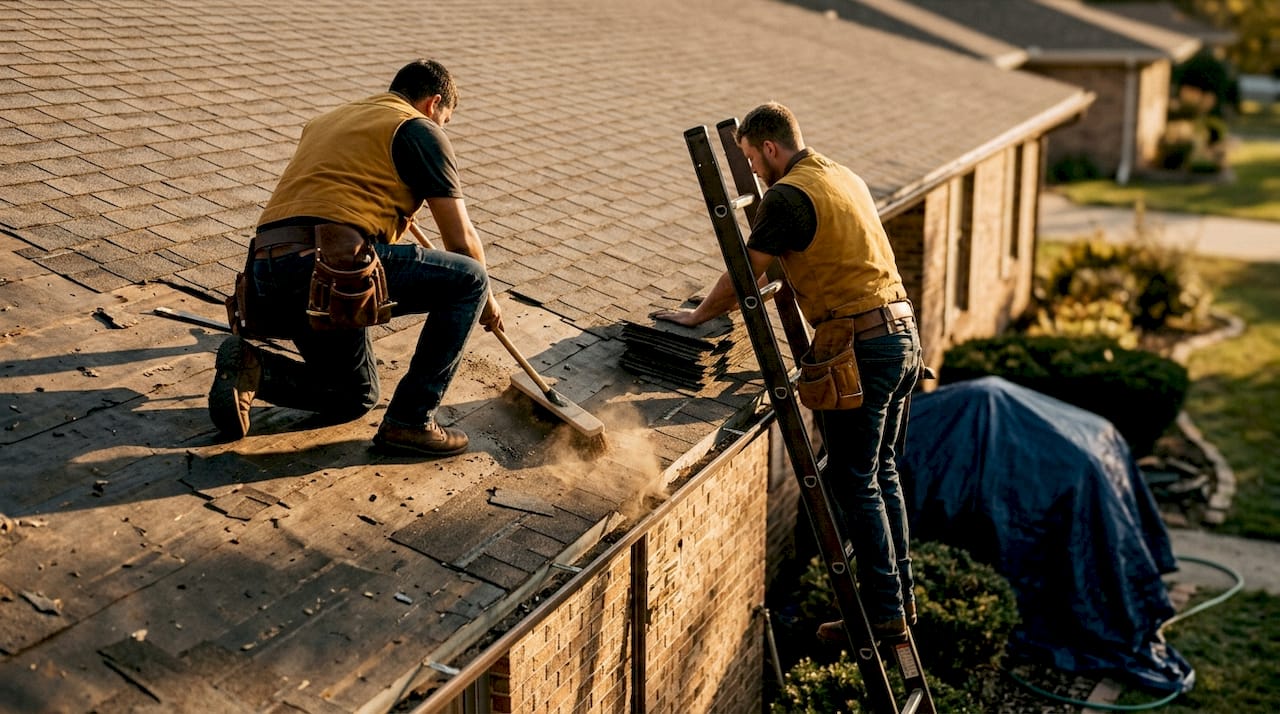
- Tear off old materials. Workers remove all existing shingles, underlayment, and flashing right down to the bare wood decking.
- Inspect and repair the decking. The process includes checking every board for rot, soft spots, or water damage. Damaged sections get replaced before anything goes over them.
- Install ice and water shield. In North Georgia, this membrane goes along eaves and in valleys where water tends to collect during heavy storms.
- Install synthetic underlayment. This protective layer goes over the rest of the deck before any shingles are applied.
- Install drip edge and flashing. Metal drip edge protects the eaves and rakes. Step flashing, valley flashing, and boot flashing seal every transition point where water could enter.
- Install ventilation components. Ridge vents, soffit vents, and any power ventilators go in to keep attic temperatures regulated and prevent moisture buildup.
- Install shingles or chosen material. Shingles start at the eaves and work upward in overlapping rows, finishing with ridge caps at the peak.
- Final inspection and cleanup. Your contractor walks the roof to confirm every detail is correct, cleans up all debris, and runs a magnetic tool over the yard to collect stray nails.
Pro Tip: For North Georgia homes, ask your contractor specifically about storm repair steps required after hail or high-wind events. These often include additional flashing upgrades that standard quotes may leave out.
If more than 25% of your roof is damaged or your asphalt shingles are approaching 20 to 25 years old, full replacement is recommended rather than piecemeal repairs. A complete replacement typically takes one day for an average-sized home with asphalt shingles, though the full claim process from inspection to final payment usually spans 10 to 14 days.
Cost breakdown: roof replacement in North Georgia
Before you get started, let’s talk numbers so you can plan smart and avoid sticker shock.
Roof costs in North Georgia fall within predictable ranges once you know what drives pricing. Here’s a clear breakdown of typical costs by material type:
| Material | Cost per sq ft | Lifespan | Best for |
|---|---|---|---|
| Asphalt architectural shingles | $5 to $8 | 25 to 30 years | Budget-conscious homeowners |
| Metal standing seam | $10 to $18 | 40 to 70 years | Long-term value, storm resistance |
| Metal shingles | $8 to $14 | 40 to 60 years | Aesthetics plus durability |
| Luxury asphalt/impact-resistant | $7 to $10 | 30 to 40 years | Storm-prone areas |
📊 Cost snapshot: According to Georgia roofing cost data, an average home with 1,700 to 2,000 square feet of roof surface typically costs $9,000 to $16,000 for asphalt shingle replacement. North Georgia pricing falls in a similar range, sometimes slightly lower depending on the county and contractor.
Several factors push your price higher or lower:
- Roof pitch (steepness). Steeper roofs require more safety equipment and slower work, increasing labor costs by 20% to 40%.
- Deck damage. If the inspectors find rotted plywood underneath, each section of replacement decking adds cost to the job.
- Code upgrades. Many older homes need upgraded ventilation, new drip edge, or improved flashing to meet current codes. These are required, not optional.
- Accessory structures. If your detached garage is also damaged, that adds to the project scope and cost.
Thinking about long-term roof value changes the math significantly. A metal roof costs two to three times more upfront but may last twice as long and deliver insurance premium discounts in storm-prone areas. For many North Georgia homeowners, that tradeoff makes financial sense over a 20-year horizon.
Navigating insurance claims for storm-damaged roofs
Costs matter, but if you’ve had storm damage, your next step is often working with your insurance company.
The insurance claim process for roof replacement has several moving parts. Missing any one of them can reduce your payout or get your claim denied entirely. Here’s how it works in Georgia:
- Document everything immediately. Take photos and video of all visible damage right after the storm, before any temporary repairs.
- Get a professional inspection. A licensed roofer’s written inspection report carries far more weight with adjusters than homeowner photos alone.
- File your claim promptly. Georgia homeowners should file storm claims within 180 days to one year of the storm event, depending on their policy. Don’t wait.
- Have your roofer present during the adjuster’s visit. This one step prevents thousands of dollars in missed damage. Your contractor knows what to look for and can point out items the adjuster might overlook.
- Review the adjuster’s estimate carefully. Items like flashing, drip edge, ventilation upgrades, and ice-and-water shield are frequently missed in initial estimates.
- File a supplement if needed. If your roofer finds additional damage or required code upgrades not included in the initial estimate, a supplement gets filed to adjust the payout.
Understanding the difference between RCV (Replacement Cost Value) and ACV (Actual Cash Value) policies is essential:
| Policy type | What it pays | Best for |
|---|---|---|
| RCV (Replacement Cost Value) | Full replacement cost after deductible | Recommended for most homeowners |
| ACV (Actual Cash Value) | Replacement cost minus depreciation | Results in significantly lower payouts |
Georgia homeowners should know that wind and hail deductibles are often separate from your standard deductible, typically ranging from 1% to 5% of your home’s insured value. On a $300,000 home, that’s $3,000 to $15,000 out of pocket before coverage kicks in. Read your policy carefully before assuming you know your deductible amount.
Pro Tip: Review our roof insurance essentials guide before your adjuster visits. Being prepared with the right questions can meaningfully improve your final settlement. You can also follow our claims guide for North GA for county-specific guidance on filing and deadlines.
Choosing materials and the right roofer: North Georgia considerations
Finally, let’s address the two most important decisions you’ll make: your material and your contractor.
North Georgia faces real storm risks every year. Hail, high winds, and tornadoes are common weather events across Paulding, Cherokee, Bartow, and surrounding counties. Your roofing material choice directly affects how well your home holds up in the next storm.
Material recommendations for North Georgia:
- Class 4 impact-resistant shingles are the top recommendation for hail-prone areas. They reduce damage in severe storms and may qualify you for an insurance discount.
- Metal standing seam roofing performs extremely well against wind and hail. Though the upfront cost is higher, metal offers superior long-term ROI in stormy Georgia conditions.
- Standard three-tab shingles are the cheapest option but perform poorly in hail and offer the shortest lifespan. We generally don’t recommend them for North Georgia homes.
Choosing the right contractor matters just as much as choosing the right material. After a major storm, out-of-state “storm chasers” flood North Georgia neighborhoods with flyers and low bids. Here’s why that’s risky: local established roofers understand Georgia’s building codes, have relationships with local insurance adjusters, and will be here after the job is done if any warranty issues arise. Storm chasers often disappear as fast as they appear.
When interviewing contractors, ask for:
- Georgia contractor’s license number (verifiable with the state)
- Proof of general liability and workers’ compensation insurance
- Local references from North Georgia homeowners
- Experience specifically with insurance claim-assisted replacements
Working with licensed local contractors protects you legally, financially, and practically throughout the replacement process.
The truth about roof replacement after storms: what most guides miss
You’ve covered all the practicals, so here’s what we’ve seen over years of helping Georgia homeowners recover from storms.
Most guides focus on the process and pricing, and those details matter. But the real challenge we see time and again isn’t information, it’s the pressure homeowners feel right after a storm to make fast decisions. Someone knocks on your door with a “special storm deal,” your roof is visibly damaged, and signing feels like relief. We get it. But that pressure leads to some of the most expensive mistakes we’ve seen.
The first hidden cost is choosing repair when replacement is truly needed. We’ve walked homes where a previous contractor patched 15% of the roof after a storm, only for the homeowner to discover two years later that moisture had been creeping under the adjacent undamaged sections the whole time. Attic mold, rotted decking, and interior water damage added tens of thousands of dollars to what started as a “money-saving” repair. The honest answer post-storm is often the more expensive one upfront, but it’s cheaper over the life of the home.
The second overlooked truth is about code upgrades. When we replace a roof, building codes in most North Georgia counties require us to bring the entire system up to current standards. That means upgraded ventilation, correct drip edge installation, and proper flashing at every penetration. Some contractors skip these upgrades to win a bid on price. That shortcut gets caught at inspection, creates delays, or worse, leaves you with a non-code-compliant roof that causes problems when you file a future insurance claim or sell the home.
Finally, the true long-term value of a full quality replacement is almost always underestimated. Homeowners focus on today’s cost. We focus on what your roof will do for your home over the next 30 to 50 years, and the peace of mind that comes from knowing it was done right. That’s the perspective that drives every replacement we do in North Georgia.
How Infinity Roofing GA can help you with stress-free roof replacement
If you’re ready to move forward or still have questions, here’s how to get personal help.
At Infinity Roofing GA, we’ve been helping North Georgia homeowners navigate storm damage and roof replacement since 2018. We handle the entire process: free inspection, insurance claim assistance, code-compliant installation, and follow-up. You don’t have to figure this out alone.

Our team is licensed, insured, and deeply familiar with how insurance adjusters work in this region. We show up to adjuster meetings, we file supplements when needed, and we use premium materials built for Georgia’s storms. Our storm damage repair services cover everything from initial inspection to final walkthrough. If you need help understanding your policy or claim, our insurance claim guidance resource is a great place to start. Reach out today for a free inspection and same-day response. No pressure. Just honest, local help.
Frequently asked questions
What does roof replacement involve compared to repairs?
Replacement means removing all materials down to the deck and rebuilding from scratch with a code-compliant system, while repairs address only specific damaged spots on an otherwise sound roof.
How do I know if insurance will cover my roof replacement after a storm in Georgia?
If more than 25% of your roof is damaged or materials can’t be matched, insurance typically covers full replacement. File quickly with strong photo documentation and a professional inspection report to support your claim. Full replacement is recommended for roofs with widespread storm damage or nearing the end of their lifespan.
What’s the typical cost of roof replacement in North Georgia?
Expect $9,000 to $16,000 for an average asphalt shingle roof on a 1,700 to 2,000 square foot home. Metal roofing costs more upfront but delivers a longer lifespan and better storm resistance.
How long does a roof replacement take after storm damage?
Most complete replacements take about one day for asphalt shingles, with the full insurance claim process from inspection to final payment typically resolving in 10 to 14 days.
What materials are best for storm-prone North Georgia roofs?
Impact-resistant Class 4 shingles or metal roofing offer the best protection and long-term value for North Georgia homeowners dealing with frequent hail and high-wind events.