A roof that looks fine from your driveway can be hiding serious structural problems after a hailstorm. North Georgia homeowners face this challenge regularly, especially during peak storm season from spring through early fall. What you can’t see from the ground can cost you thousands in out-of-pocket repairs and, worse, a denied insurance claim. This guide walks you through every step of identifying, documenting, and reporting hail damage correctly so your claim gets approved and your home stays protected.
Table of Contents
- Understanding hail damage and its impact on your roof
- Checklist: What to do after a hailstorm
- Professional hail damage inspections: How to document for insurance
- Filing a hail damage claim: What North Georgia homeowners should expect
- Common mistakes and expert tips for successful hail damage reporting
- A seasoned take: What most guides miss about hail damage reporting
- Connect with North Georgia’s trusted roof repair and claim experts
- Frequently asked questions
Key Takeaways
| Point | Details |
|---|---|
| Hidden hail damage matters | Subtle roof damage can lead to denied claims if not properly inspected and documented. |
| Documentation is key | Photos, videos, and detailed reports are essential for claim approval and insurance communication. |
| Professional inspections add credibility | Structured roof assessments and evidence-based reports increase your chances of claim success. |
| Test squares are just samples | Sampling one roof area does not reflect the whole roof’s condition, so multiple locations should be checked. |
| Temporary repairs are reimbursable | Covering damaged spots and keeping receipts can support your claim and prevent further damage. |
Understanding hail damage and its impact on your roof
Not all hail damage looks the same. Some impacts are obvious: large dents in gutters, cracked shingles, or holes in soffit panels. But the damage that’s most likely to hurt you financially is the kind you can barely see. Subtle hail impacts like bruising, tiny cracks in the asphalt, and dislodged granules rarely show up from street level, yet a professional inspection can detect them and document exactly what’s needed for your claim.
Understanding the distinction between functional and cosmetic damage is critical when dealing with your insurer. Functional vs. cosmetic damage determines whether your policy actually pays. Functional damage affects your roof’s ability to do its job, specifically keeping water out and protecting your home’s structure. Cosmetic damage is surface level and may not affect performance, though it can impact resale value and curb appeal.
Here’s what adjusters in North Georgia are looking for when they inspect for hail damage:
| Damage type | What it looks like | Why it matters |
|---|---|---|
| Granule loss | Bare spots or granule buildup in gutters | Accelerates shingle deterioration |
| Bruising | Soft, spongy spots on shingles when pressed | Weakens structural integrity |
| Cracked shingles | Splits across the surface | Allows moisture infiltration |
| Bent/dented flashing | Distortion around vents and chimney | Creates leak pathways |
| Damaged ridge caps | Impacts along the ridge line | Common hail strike target |
Common damage patterns we see in North Georgia typically involve:
- Granule loss in concentrated areas, indicating hailstone impact clusters
- Cracked or displaced ridge caps, since ridge lines take direct hits
- Damaged step flashing around chimneys and skylights
- Dented aluminum gutters and downspouts
- Bruised shingles that look discolored or slightly indented
For a deeper look at how Georgia roof insurance basics apply to storm events, it helps to understand your specific policy terms before a storm even hits. Use our roof insurance claims guide to understand what your adjuster will be checking when they arrive.
Checklist: What to do after a hailstorm
The first 24 to 72 hours after a hailstorm are the most important for setting up a successful claim. Acting quickly and systematically protects both your home and your legal standing with your insurer.
Ground-level inspection first. Never climb your roof immediately after a storm. It’s wet, potentially weakened, and dangerous. Instead, walk around the perimeter and look for:
- Dented gutters or downspouts
- Cracked window screens or siding
- Debris, granules, or broken shingles on the ground
- Visible impacts on any metal surfaces (AC unit, vents, caps)
Once you’ve assessed safely from the ground, follow these steps:
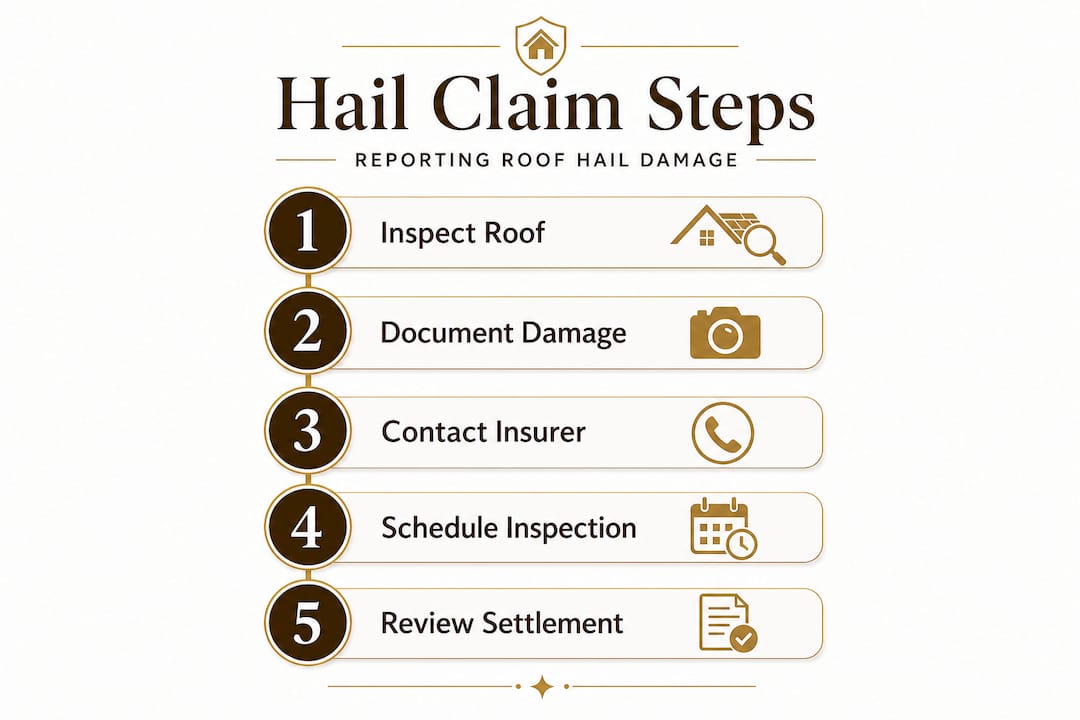
- Document everything with photos and video. Take wide-angle shots of your home’s exterior, then close-up shots of every area showing visible damage. Photograph granule buildup in gutters. Record a video walkthrough of your yard and all exterior surfaces. Photo and video documentation is one of the strongest supports for a claim.
- Cover any open areas immediately. If you can see obvious holes or broken shingles, cover them with a heavy-duty tarp and secure the edges. Keep all receipts for tarps, plastic sheeting, or any materials used for temporary weatherproofing. Your insurer can reimburse those costs.
- Write down the date and time. Note exactly when the storm occurred. This helps connect your damage to the specific weather event during the claims process.
- Contact your insurance company to report the event. You don’t need an inspection report yet, just notify them that a storm occurred and that you believe your property may have been affected.
- Schedule a licensed roofing inspection. This is your most critical step. Georgia adjusters look for visible hail evidence including granule loss, cracked shingles, and damaged flashing. Having an independent roofer’s report before the adjuster visits strengthens your position.
Pro Tip: Take “before” photos of your roof at least once a year in early spring. If a storm hits, you’ll have a clear comparison showing that damage didn’t exist before the hail event. This closes one of the most common loopholes insurers use to dispute claims.
Learn more about how to repair storm damaged roofs when temporary fixes aren’t enough. If the damage looks extensive, our team offers urgent roof repair estimates the same day you call.
Professional hail damage inspections: How to document for insurance
A proper hail damage inspection goes well beyond a quick visual check. Roofing professionals and independent inspectors use a method called the test-square system. This involves marking off a 10-foot by 10-foot section of the roof in multiple locations and carefully counting every visible hail impact within each square. The 10×10 test square is a sample, not a complete picture of the entire roof’s condition. That distinction matters.

Here’s a comparison of what a thorough inspection captures versus a basic walk-through:
| Inspection element | Basic walk-through | Structured professional inspection |
|---|---|---|
| Test square measurements | None | Multiple 10×10 sections across all slopes |
| Impact count | Estimated | Documented per square |
| Photo evidence | General overview | Close-up, labeled, and GPS-tagged |
| Functional vs. cosmetic classification | Often skipped | Documented for each damage type |
| Weather event correlation | Not included | Cross-referenced with hail data |
The goal of a structured inspection is to produce a report that an adjuster can evaluate without relying on personal impressions. Consistent, objective language matters. Vague descriptions like “some damage noted” won’t cut it. A quality inspection report uses specific language: “14 functional impacts observed in northwest test square, consistent with 1.5-inch hailstone impacts.”
Here’s what to expect during a professional inspection:
- Roof slope-by-slope coverage, since hail rarely hits all areas equally
- Attic inspection for signs of water intrusion or structural movement
- Documentation of all secondary damage: flashing, vents, skylights, gutters
- Labeling and geo-tagging of photos so adjusters can match images to roof locations
Pro Tip: Ask your inspector to follow the IBHS hail testing protocol as a benchmark for distinguishing real impacts from manufacturing defects or pre-existing wear. This adds an objective industry standard to your report and gives you credibility with skeptical adjusters.
Review our full breakdown of storm damage claims steps and make sure your inspector is licensed and compliant before they set foot on your roof.
Filing a hail damage claim: What North Georgia homeowners should expect
Once your inspection report is ready, the claims process moves into a more formal phase. Here’s how it typically unfolds in Georgia:
- Submit your claim with your policy number, the storm date, and a brief description of the damage.
- Your insurer assigns an adjuster who will schedule a visit, usually within 5 to 14 days of your claim submission.
- The adjuster conducts their own inspection. They will look for the same evidence your roofer documented. Georgia adjusters focus on visible hail damage, documentation quality, and whether damage is consistent with the reported storm event.
- Your adjuster produces an initial estimate. This can change. New evidence, supplemental inspections, and additional damage found during repairs frequently lead to updated numbers.
- You receive a scope of work and payment offer. Review this carefully against your contractor’s estimate. Gaps in coverage are common and can often be negotiated.
One factor many homeowners overlook is storm verification. Insurers want to connect your specific damage to a specific storm event. This is where weather data becomes powerful.
“Pairing roof-condition documentation with storm verification, including timing, hail size, and weather data, creates a forensic connection to the hail event that adjusters cannot easily dismiss.”
Hail size matters in particular. A 1-inch hailstone causes very different damage than a 2-inch stone. If your area was hit by large hail on a documented date, that data strengthens every element of your claim. Your roofing contractor should help you pull storm verification data as part of the claims support process.
Understanding why choosing an insured roofer matters becomes clear at this stage. Your contractor needs to stand behind their inspection report, work with your adjuster, and document everything correctly. Our repair vs. replacement guide also helps you understand what outcome to expect once your claim is approved.
Common mistakes and expert tips for successful hail damage reporting
Even with a solid inspection and thorough documentation, claims get denied or reduced because of avoidable mistakes. Here are the most common ones we see from North Georgia homeowners:
- Relying on one test square. Zero observed impacts in a single sample square does not mean the roof is undamaged. Sampling error is real. Hail strikes are not evenly distributed, and one clear square doesn’t represent the whole roof.
- Using vague or inconsistent location descriptions. If your report says “rear slope” but photos show three different areas, an adjuster will question the accuracy of the entire report.
- Skipping granule loss documentation. Granule buildup in gutters is powerful evidence. Many homeowners don’t think to photograph it.
- Waiting too long to file. Georgia has specific statutes of limitations for property insurance claims. Acting within the first few weeks of a storm event is strongly recommended.
- Accepting the first estimate without review. Initial adjuster estimates routinely miss secondary damage. Always have your contractor review the scope before you accept a settlement.
Expert tips to maximize your claim:
- Reference hail-resistant shingle benchmarks to show what your existing shingles were rated for and document when they failed below that threshold.
- Request a joint inspection with your roofer present when the adjuster visits. This allows real-time clarification and prevents your evidence from being misread.
- Keep a written record of every phone call, email, and meeting with your insurer, including dates, names, and what was discussed.
For a full breakdown of storm claim reporting tips, we recommend reviewing what adjusters look for before your meeting.
A seasoned take: What most guides miss about hail damage reporting
Most online guides stop at “take photos and call your insurer.” That advice isn’t wrong, but it’s incomplete in ways that cost North Georgia homeowners real money. Here’s what we’ve learned from years of working through storm damage claims in this region.
Insurance adjusters are not your advocates. They are professionals doing a job for their employer, and their job is to assess claims accurately, not generously. That doesn’t make them the enemy. But it does mean that the quality and depth of your documentation determines how your claim is valued. A vague report gives an adjuster more room to downgrade or deny. A precise, well-structured report with labeled photos, test-square data, and weather verification leaves very little room for dispute.
We also see homeowners assume that newer roofs won’t suffer serious hail damage. That’s not accurate. Even a roof installed one year ago can sustain functional damage from large hail. The age of the material matters far less than the size and density of the hailstones. A structured deep-dive into roof insurance will show you that coverage triggers are based on the cause and degree of damage, not the age of the material alone.
The real difference between a homeowner who gets their roof replaced at minimal cost and one who gets stuck with a large out-of-pocket bill often comes down to one thing: whether they had a professional in their corner before the adjuster arrived, not after. Don’t wait for your insurer to set the tone of the inspection. Get your own expert report first. Then let the adjuster’s findings either confirm or challenge what you already have in writing.
Connect with North Georgia’s trusted roof repair and claim experts
If you’ve just experienced a hailstorm and aren’t sure where to start, we’re here to help. At Infinity Roofing GA, we’ve been guiding North Georgia homeowners through storm damage and insurance claims since 2018. We know what adjusters in this region look for, and we know how to document your roof so nothing gets missed.

Our storm damage repair services include fast inspections, detailed reporting, and full claim support from start to finish. Use our storm roof repair guide to understand your repair options, or review our roof claim support resource to prepare for every step of the insurance process. Same-day estimates are available. We’re licensed, insured, and ready to put our local expertise to work for you.
Frequently asked questions
How can I tell if hail damage is functional or cosmetic?
Functional damage compromises your roof’s ability to resist weather and water, while cosmetic damage only affects appearance. A structured professional assessment is the most reliable way to distinguish the two and confirm what your insurer will cover.
Do I need photos and receipts to file a hail damage claim?
Yes. Detailed photos, videos, and receipts for temporary repairs are essential. Documentation supports insurance claims by providing clear, timestamped evidence of damage and the steps you took to prevent further loss.
What happens if the adjuster finds no damage in the test square?
Zero impacts in one sample square do not confirm an undamaged roof. Sampling error is documented and adjusters should evaluate multiple test locations across different roof slopes before reaching any conclusions.
Can I use IBHS impact-resistant shingle ratings in my claim?
You can reference IBHS shingle performance ratings as benchmarks to show how your materials were expected to perform, but these ratings are not used as direct standards for claim approval or denial.
Should I cover roof openings after hail damage?
Yes, immediately. Covering damaged areas with tarps or plastic and keeping all receipts is both a safety measure and a claim documentation requirement. Failing to weatherproof can give your insurer grounds to deny costs related to secondary water damage.