Best roofing practices in 2026 are defined by updated code compliance, precise material installation, and energy-efficiency standards that protect your home for decades. The IRC 2024 sets the baseline for ventilation ratios, underlayment layering, ice and water barriers, and drip edge flashing. Homeowners and property managers who follow these standards avoid costly failures, insurance disputes, and warranty voids. This guide covers every major roofing element, from attic ventilation design to cool roof compliance, so you can make confident decisions and hold your contractor accountable.
1. Best roofing practices 2026: ventilation design and sizing
Proper attic ventilation is the foundation of a long-lasting roof. The IRC 2024 standard requires a minimum of 1 sq. ft. of net free vent area per 150 sq. ft. of attic floor. That ratio drops to 1:300 when you combine balanced intake and exhaust placement with a Class II or better vapor retarder on the warm-in-winter ceiling side. That reduction matters because it gives you more design flexibility without sacrificing moisture control.
Balanced ventilation means distributing vent area correctly, not just meeting the total number. The code calls for 40% of vent area as intake through low soffit vents and 60% as exhaust through high ridge or upper vents. Power ventilators can supplement this system but cannot replace passive intake. Placing all vents at the same height, a common field mistake, creates dead zones where warm, moist air stagnates and causes condensation damage.
Key ventilation best practices for 2026:
- Use soffit vents for intake and ridge vents for exhaust to create a natural convective flow.
- Install a Class II vapor retarder on the warm-in-winter ceiling side when targeting the 1:300 ratio.
- Never block soffit vents with insulation. Use baffles to maintain a clear airway from eave to ridge.
- Avoid mixing ridge vents with upper gable vents. This short-circuits airflow and reduces exhaust efficiency.
- Verify intake and exhaust balance before final inspection, not just total vent area.
Pro Tip: Calculating total vent area is not enough. Walk the attic after installation and confirm that intake vents at the eaves are clear and that exhaust vents are positioned at or near the ridge. An imbalanced system causes more moisture damage than no ventilation at all.
2. Ice and water barrier installation: what the 2026 code requires
Ice and water barriers are self-adhering polymer-modified bitumen membranes that protect against ice dam backup and wind-driven rain. The critical measurement most homeowners miss is that the barrier must extend 24 inches inside the exterior wall line horizontally, not simply 24 inches up from the gutter edge. This distinction matters because deep overhangs can push the required coverage point much farther up the roof deck than a simple vertical measurement suggests.
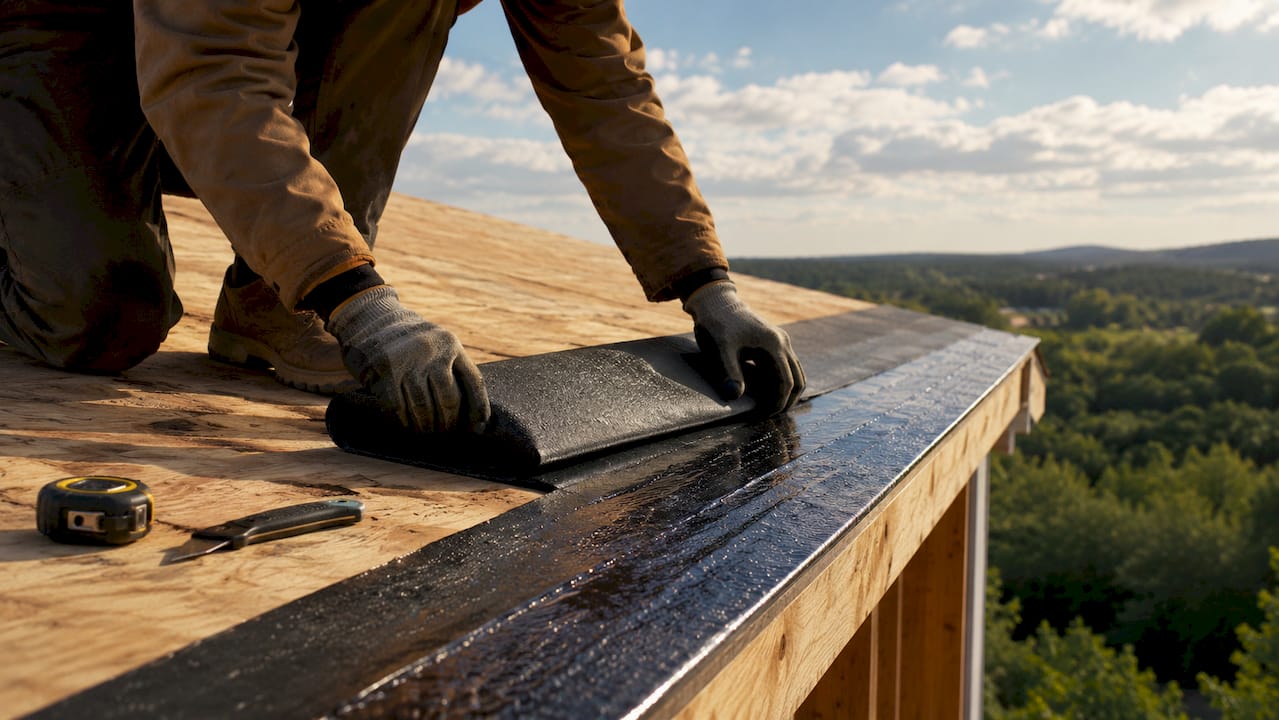
Many field failures trace back to underestimating how much membrane is needed. Roofs with wide overhangs, complex geometry, or multiple valleys require additional membrane courses to maintain continuous coverage. Sidewall transitions and valley intersections are the two most common spots where contractors cut coverage short.
Ice and water barrier best practices:
- Measure coverage to the warm-wall line horizontally, not from the gutter edge vertically.
- Apply multiple overlapping courses for roofs with overhangs deeper than 12 inches.
- Cover all valleys with ice and water shield regardless of climate zone.
- Extend barrier up sidewalls and around chimneys where water can back up.
- Use self-adhering polymer-modified bitumen membrane for maximum adhesion and flexibility.
Pro Tip: Hire a licensed roofing contractor who knows your local climate zone and uses precise horizontal measurements. A contractor who measures only from the gutter edge will leave your home exposed to ice dam damage every winter.
For a deeper look at how ice dams form and how to prevent them, the ice dam prevention guide from The Clean Genius is a solid reference.
3. Underlayment requirements for asphalt shingle roofs
Underlayment is the secondary water barrier between your shingles and the roof deck. The IRC 2024 requires one layer of ASTM D226 Type I (#15 felt) or a synthetic equivalent for asphalt shingle roofs on slopes of 4:12 and above. For lower slopes between 2:12 and 4:12, two layers are required in an offset pattern that staggers laps to prevent water infiltration at seams.
The sequencing of underlayment and ice and water shield is where many roofs fail inspection. Ice and water shield at the eaves must be installed under the standard felt or synthetic underlayment, not over it. This allows any water that gets past the shingles to drain outward over the felt rather than being trapped beneath it. The underlayment system functions as an integrated assembly, and sequencing errors break that assembly.
Key underlayment rules for 2026:
- Slopes 4:12 and above: one layer of #15 felt or approved synthetic underlayment.
- Slopes 2:12 to 4:12: two layers in an offset pattern with the first course doubled at the eave.
- Ice and water shield is mandatory at eaves in cold climates and in all valleys regardless of climate.
- Install ice and water shield below standard underlayment at eaves to allow outward drainage.
- Verify that your underlayment choice is accepted by your shingle manufacturer. Some warranties require specific synthetic products.
Choosing the right underlayment also affects your wind-driven rain resistance. Synthetic underlayments generally outperform #15 felt in high-wind conditions and are less prone to tearing during installation. For North Georgia homeowners dealing with storm exposure, this is a practical upgrade worth the modest cost difference.
4. Drip edge flashing: sequencing and standards for 2026
Drip edge flashing is mandatory on both eaves and rakes for all asphalt shingle roofs under the IRC 2024. The material must be a minimum of 26-gauge corrosion-resistant metal, either galvanized steel or aluminum, and must extend at least 1/4 inch beyond the fascia to direct water into the gutter rather than behind it.
The sequencing rule is where most installation errors occur. At eaves, drip edge goes under the underlayment. At rakes, drip edge goes over the underlayment. Reversing this sequence at either location creates a direct leak path even when the materials themselves are correct. Sequencing errors are one of the most common sources of water intrusion found during inspections.
Drip edge installation checklist:
- Eaves: install drip edge directly on the roof deck, then apply underlayment over it.
- Rakes: install underlayment first, then apply drip edge over the underlayment.
- Overlap drip edge sections by at least 2 inches and fasten every 12 inches along the flange.
- Verify the 1/4-inch minimum overhang beyond the fascia at every section.
- Use galvanized steel in areas with high humidity or salt exposure for longer service life.
Pro Tip: After installation, run your hand along the drip edge to confirm it lies flat and tight against the roof deck. Any gaps or raised sections create entry points for wind-driven water. A flat, well-fastened drip edge is one of the simplest and most effective leak prevention measures you can verify yourself.
5. Cool roof materials and compliance standards for 2026
Cool roofs are defined by their solar reflectance (SR) and thermal emittance values, not simply by color. For commercial low-slope roofs, ENERGY STAR requires an initial SR of 0.65 or higher, while ASHRAE 90.1-2022 sets a Solar Reflectance Index (SRI) threshold of 82 or above in hot climate zones. California Title 24 applies stricter aged reflectance and emittance requirements, meaning products must maintain performance over time, not just when new.
Compliance depends on verified product data, not visual inspection. The Cool Roof Rating Council (CRRC) maintains a rated products directory where you can confirm that a specific product meets the SR and emittance thresholds for your climate zone. Selecting a product without checking its CRRC-rated data sheet is a procurement error that can trigger code violations during inspection.
| Material | Application | Key Performance Metric | Climate Zone Fit |
|---|---|---|---|
| White TPO membrane | Commercial low-slope | SR ≥ 0.65, high emittance | Hot and mixed climates |
| PVDF-coated metal standing seam | Residential and commercial | Aged SR meets ASHRAE 90.1-2022 | Hot climates, avoid cold zones |
| IMP (Insulated Metal Panel) | Commercial walls and roofs | High SRI, integrated insulation | Hot and mixed climates |
| Reflective asphalt shingles | Residential steep-slope | ENERGY STAR rated SR | Mixed climates |
One caution for North Georgia homeowners: cool roofs reduce cooling loads in summer but can slightly increase heating loads in winter. In mixed climate zones, the net energy benefit is positive but smaller than in purely hot climates. Weigh the energy savings against your heating season length before specifying a high-reflectance product on a residential steep-slope roof. For sustainable roofing options that balance efficiency and climate fit, local expertise matters.
Key takeaways
The best roofing practices in 2026 require code-aligned ventilation, precise barrier installation, correct underlayment sequencing, and verified cool roof ratings to protect your home and maintain warranty coverage.
| Point | Details |
|---|---|
| Ventilation ratio matters | Use 1:150 as the baseline, or reduce to 1:300 with balanced vents and a Class II vapor retarder. |
| Ice barrier measurement is horizontal | Measure 24 inches to the warm-wall line, not from the gutter edge, to avoid ice dam failures. |
| Underlayment sequencing is critical | Install ice and water shield under felt at eaves to allow outward drainage and prevent trapped water. |
| Drip edge sequence differs by location | Eaves require drip edge under underlayment; rakes require drip edge over underlayment. |
| Cool roof compliance needs verified data | Check CRRC-rated product sheets for SR and SRI values before purchasing any cool roof material. |
What I’ve learned from years of watching roofs fail
The most expensive roofing failures I see are not caused by cheap materials. They are caused by correct materials installed in the wrong sequence. A contractor can use code-approved drip edge, quality synthetic underlayment, and a premium ice and water barrier and still produce a leaking roof if the sequencing is wrong. That is the part most homeowners never think to ask about.
The second pattern I see constantly is homeowners who assume ventilation is fine because they have ridge vents. Ridge vents without clear soffit intake are nearly useless. The air has nowhere to enter, so the ridge vent just sits there. I have walked attics with ridge vents installed correctly but soffit vents completely blocked by insulation. The attic was holding moisture like a greenhouse.
My honest advice: before you sign off on any roofing project, ask your contractor to walk you through the ventilation intake and exhaust distribution, the ice barrier horizontal measurement, and the drip edge sequencing at both eaves and rakes. A qualified contractor will answer those questions without hesitation. One who cannot answer them is telling you something important. Document every product used, including the manufacturer’s rated data sheet for any cool roof material. That documentation protects your warranty and your insurance claim if something goes wrong later. You can also review roof stormproofing strategies to understand how all these systems work together under real weather conditions.
— Dan
Get code-compliant roofing help from Ir-ga
If your roof needs repairs, a full replacement, or a post-storm assessment, Ir-ga is ready to help. We are a licensed and insured roofing contractor serving homeowners and businesses across North Georgia, and we have been doing this since 2018.

Our team handles everything from storm damage repair to full replacements, and we manage the insurance claim process so you get maximum coverage without the stress. We know the 2026 code requirements inside and out, and we use premium materials with verified ratings. If you are not sure whether to repair or replace, our step-by-step repair guide walks you through the decision. Contact Ir-ga today for a same-day response and an honest assessment from a neighbor you can trust.
FAQ
What is the minimum ventilation ratio for attic roofs in 2026?
The IRC 2024 requires 1 sq. ft. of net free vent area per 150 sq. ft. of attic floor. That ratio reduces to 1:300 when balanced intake and exhaust vents are combined with a Class II vapor retarder on the warm-in-winter ceiling side.
How far must ice and water barrier extend up the roof?
The barrier must extend at least 24 inches inside the exterior wall line measured horizontally, not vertically from the gutter edge. Deep overhangs require additional membrane courses to reach that measurement point.
What underlayment does an asphalt shingle roof need?
Slopes of 4:12 and above require one layer of ASTM D226 #15 felt or an approved synthetic. Slopes between 2:12 and 4:12 require two layers in an offset pattern, with ice and water shield at all eaves in cold climates and all valleys in every climate.
Does drip edge go under or over underlayment?
The answer depends on location. At eaves, drip edge installs under the underlayment. At rakes, drip edge installs over the underlayment. Reversing this sequence at either location creates a leak path regardless of material quality.
What makes a roof qualify as a cool roof in 2026?
A cool roof must meet verified solar reflectance and thermal emittance thresholds from the CRRC. For commercial low-slope applications, ENERGY STAR requires an initial SR of 0.65 or higher, and ASHRAE 90.1-2022 sets an SRI threshold of 82 in hot climate zones. Visual color alone does not confirm compliance.