If you’ve noticed dark streaks, green patches, or fuzzy growth spreading across your roof, you’re not alone. Most North Georgia homeowners assume the fix is a powerful blast of water. The reality is that pressure washing your roof can strip protective granules, crack shingles, and void your manufacturer’s warranty in one afternoon. That’s where soft wash roof cleaning comes in. It’s a proven, low-pressure method that removes biological growth at the source without causing the damage that high-pressure equipment leaves behind. This guide breaks down exactly how it works and why it matters for your home.
Table of Contents
- What is soft wash roof cleaning? How does it work?
- Why is soft washing preferred over pressure washing for roof cleaning?
- The soft wash roof cleaning process step-by-step
- Important safety and environmental considerations for homeowners
- How to choose the right soft wash roof cleaning professional in North Georgia
- Our take: the biggest mistake homeowners make with roof cleaning
- Ready to protect your roof? We can help.
- Frequently asked questions
Key Takeaways
| Point | Details |
|---|---|
| Soft wash defined | Soft wash roof cleaning uses low pressure combined with chemical dwell to safely remove biological growth. |
| Pressure vs soft wash | Soft washing preserves roof materials unlike high-pressure washing that risks damage and voiding warranties. |
| Chemical dwell time | Effectiveness depends on allowing the bleach solution 10 to 30 minutes to kill algae and moss before rinsing. |
| Safety first | Handling of sodium hypochlorite requires trained professionals following OSHA standards to protect people and environment. |
| Choose qualified pros | Ask contractors about their inspection, protection, and post-treatment verification steps for best results. |
What is soft wash roof cleaning? How does it work?
Soft washing is a cleaning method that uses very low water pressure, typically 500 PSI (pounds per square inch) or less, combined with a specialized chemical solution to remove biological growth from your roof. Instead of blasting away algae, moss, and lichen with sheer force, the chemicals do the heavy lifting.
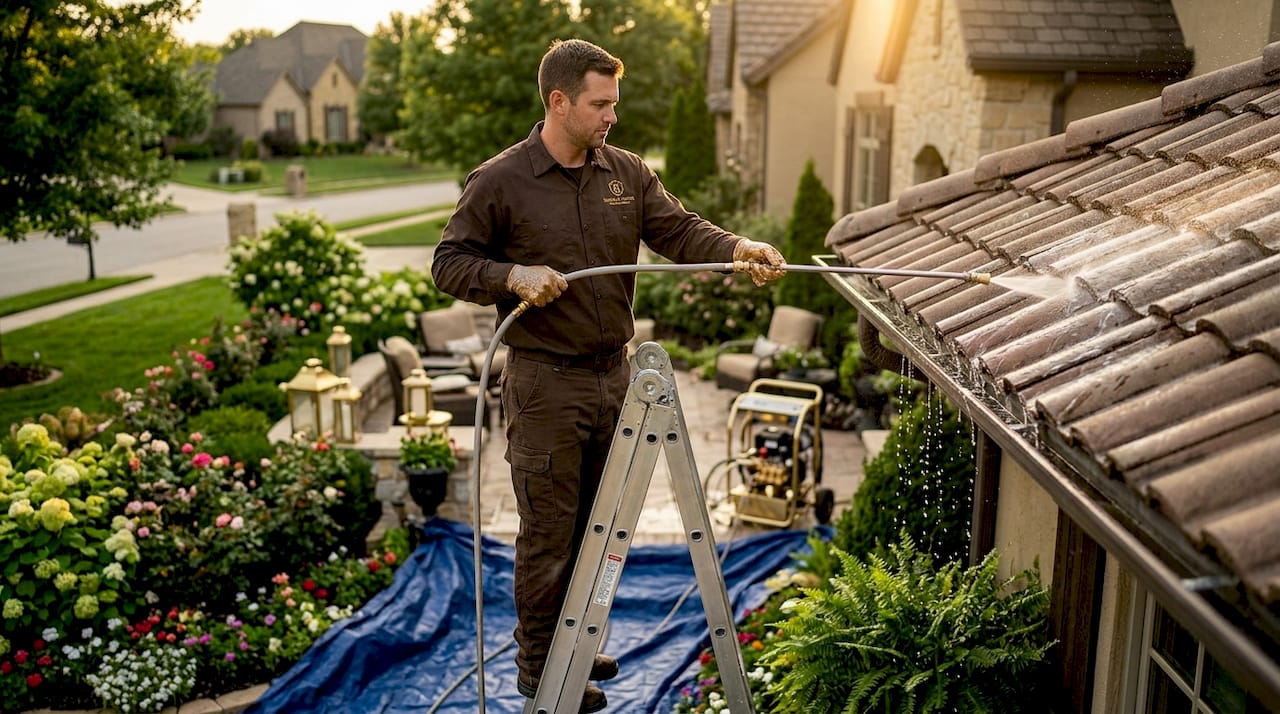
The primary active ingredient is diluted sodium hypochlorite, which is a form of bleach, paired with surfactants. Surfactants are soap-like agents that help the solution cling to the roof surface longer. Together, they penetrate and kill the root systems of algae, moss, lichen, and the bacteria responsible for those dark black streaks you see on many roofs in humid climates like North Georgia.
Here’s what makes the method effective:
- Low pressure application: Water pressure stays well below 500 PSI, compared to thousands of PSI used in standard pressure washing
- Chemical dwell time: The solution sits on the roof surface for 10 to 30 minutes, allowing it to fully neutralize biological organisms at the root level
- Safe rinsing: After dwell time, a gentle low-pressure rinse clears away the dead residue without disturbing shingle granules
- Warranty protection: Because no mechanical force is applied to shingles, your roof’s manufacturer warranty stays intact
As the National Roof Cleaning Authority explains, soft wash roof cleaning is a low-pressure method using sodium hypochlorite plus surfactant applied with chemical dwell time to remove biological growth rather than mechanical pressure. You can learn more about what this looks like in practice through our roof cleaning overview.
Why is soft washing preferred over pressure washing for roof cleaning?
Understanding what soft washing is leads us to why it’s favored over pressure washing for roof maintenance. The difference comes down to how each method removes material from your roof surface, and what gets taken with it.
Pressure washing uses 1,200 to 3,500 PSI of mechanical force. That level of pressure lifts dirt, yes, but it also strips the granules embedded in asphalt shingles. Those granules protect the shingle layer beneath from UV damage and weather. Lose enough of them, and your roof ages years faster. Many roofing manufacturers specifically state that pressure washing voids the warranty, leaving you unprotected when you need coverage most.
The comparison between methods is clear: soft washing operates at 100 PSI or less using chemical dwell while pressure washing uses 1,200 to 3,500 PSI of mechanical force, risking damage and voided warranties.
| Feature | Soft washing | Pressure washing |
|---|---|---|
| Operating pressure | Under 500 PSI | 1,200 to 3,500 PSI |
| Primary cleaning agent | Sodium hypochlorite + surfactants | High-pressure water |
| Granule damage risk | Very low | High |
| Warranty impact | Preserves warranty | Often voids warranty |
| Kills biological growth at root | Yes | No, surface only |
| Safe for all roof types | Yes, when done correctly | Not recommended |
| Results longevity | Longer lasting | Shorter, regrowth faster |
Here’s something most homeowners don’t realize: pressure washing removes the visible symptom but leaves the root system of algae and moss alive. Within months, the growth comes back. Soft washing kills the organism entirely, which means results last significantly longer and you need fewer treatments over the life of your roof.
Benefits of soft washing vs. pressure washing for your roof include:
- Longer-lasting results because organisms are killed at the root, not just removed from the surface
- No shingle granule loss that shortens roof life expectancy
- Manufacturer warranty stays valid because no damaging force is applied
- Effective against all biological growth including algae, moss, lichen, mold, and bacteria
Pro Tip: Before hiring any roof cleaning company, ask directly whether they use soft washing or pressure washing on roofs. If a contractor proposes high-pressure methods on your asphalt shingles, that’s a red flag. Check what professional roof cleaning means in terms of protecting your home’s investment.
The soft wash roof cleaning process step-by-step
Now, let’s walk through what happens during a typical professional soft wash roof cleaning service. Knowing the steps helps you set the right expectations and ask the right questions before work begins.
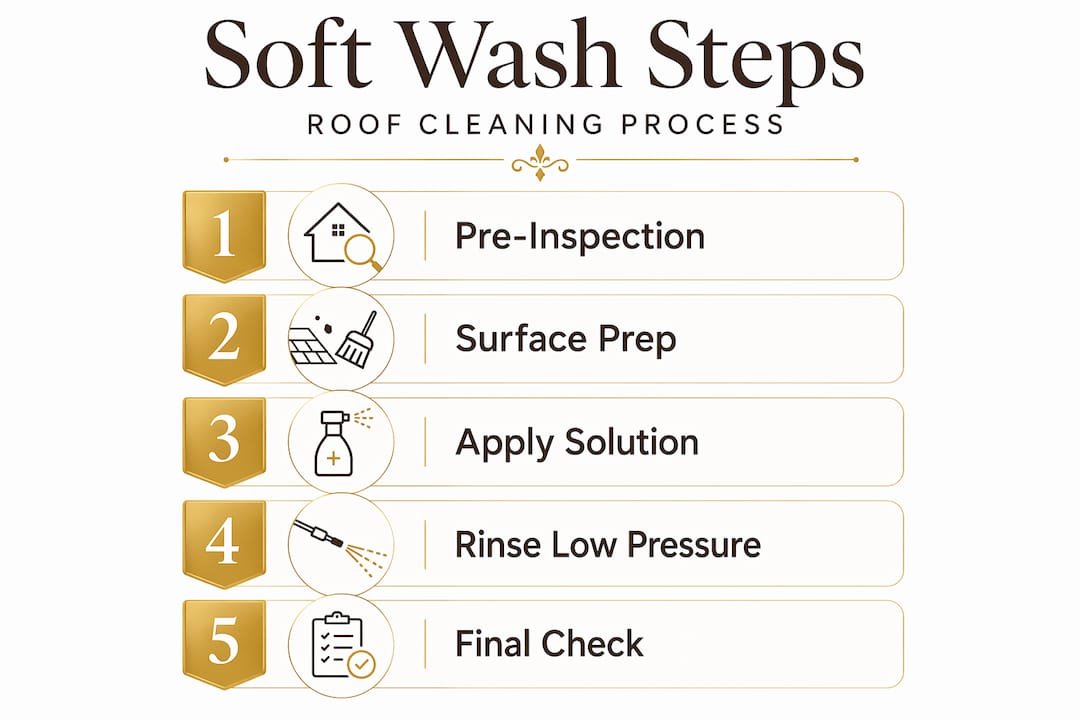
- Pre-inspection: The technician walks the roof and evaluates the type and extent of biological growth. Heavier moss infestations may require adjusted chemical concentrations or additional dwell time.
- Protecting surrounding areas: Plants, grass, gutters, and downspouts are pre-wetted with plain water. This dilutes any chemical overspray that reaches vegetation and helps prevent damage to landscaping.
- Chemical application: A diluted sodium hypochlorite solution with surfactants is applied using low-pressure spray equipment. The surfactant helps the solution adhere to the roof and penetrate organic growth rather than running off immediately.
- Dwell time: The solution remains on the roof for 10 to 30 minutes depending on the severity of biological growth. This is the critical phase where organisms are neutralized at the cellular level.
- Low-pressure rinse: The roof is rinsed gently to remove dead biological material and chemical residue. No high-pressure equipment is used at this stage.
- Post-treatment verification: The technician inspects the roof to confirm biological growth has been fully treated and that no areas were missed. Some contractors offer follow-up checks or guarantees.
The full soft wash process includes pre-inspection, surface protection, chemical application and dwell, low-pressure rinsing, and post-treatment verification to ensure safety and effectiveness. Our team follows this exact soft wash roof cleaning process on every job.
Pro Tip: Ask your contractor how they handle runoff from the chemical solution. Reputable professionals will have a plan for managing drainage to protect your yard, garden beds, and nearby water features before they ever start the job.
Important safety and environmental considerations for homeowners
In addition to the cleaning steps, understanding safety and environmental handling is vital for peace of mind. Sodium hypochlorite is an effective cleaning agent, but it’s also a strong oxidizing chemical that requires proper handling.
Here’s what responsible contractors do to protect you, your family, and your property:
- OSHA compliance: Sodium hypochlorite handling is regulated under OSHA’s Hazard Communication Standard, which requires trained application and safety precautions for all workers
- Proper dilution ratios: Trained technicians know the correct concentration for each roof type and level of biological contamination, avoiding over-application
- Runoff management: Professionals pre-wet landscaping and direct drainage away from garden beds, water features, and storm drains
- Weather awareness: Application timing is adjusted based on temperature and wind to prevent chemical drift onto neighboring properties
- Personal protective equipment: Licensed crews use proper gear to protect workers during application and rinse stages
Before hiring a contractor, ask them specifically how they comply with chemical safety standards, how they protect your landscaping, and whether their team is trained and licensed. Any reputable provider should answer these questions confidently and without hesitation.
Always confirm that the company you hire carries both liability insurance and proper licensing. This protects you if something goes wrong. You can read more about what licensed roof cleaning safety looks like and why it matters for North Georgia homeowners.
How to choose the right soft wash roof cleaning professional in North Georgia
Knowing the process and safety considerations is helpful. Now, learn how to select a reliable contractor for your home. North Georgia’s climate, with its humid summers and heavy tree canopy, creates ideal conditions for algae and moss growth. That means the contractor you choose needs to understand local biology, not just cleaning equipment.
Here’s what to look for and ask before signing anything:
- Do they perform a pre-inspection? A professional should evaluate the roof condition and growth type before quoting. Generic pricing without inspection is a warning sign.
- How do they protect landscaping and gutters? Confirm they pre-wet vegetation and have a runoff plan. This is not optional; it’s a sign of experience and accountability.
- What chemical concentrations do they use? Contractors who cannot explain their dilution ratios likely don’t understand the process well enough to be trusted with your roof.
- Do they follow safety and compliance standards? Ask about OSHA training and liability insurance. A licensed and insured contractor protects you from liability if an incident occurs on your property.
- What does post-treatment inspection involve? Quality contractors verify results before they leave and often back their work with a satisfaction guarantee.
- Can you verify local reviews? North Georgia homeowners should look for Google reviews, BBB ratings, or references from neighbors in their area.
The National Roof Cleaning Authority recommends asking contractors whether their process includes pre-inspection of biological load, protecting vegetation and drainage, and post-treatment verification, as these are critical steps for proper results and liability control. Finding qualified soft wash contractors who check all these boxes makes the difference between a job that lasts and one that causes more problems than it solves.
Our take: the biggest mistake homeowners make with roof cleaning
After serving North Georgia homeowners since 2018, we’ve seen the same pattern repeat itself. A homeowner notices staining and calls whoever offers the lowest price. That contractor shows up with a pressure washer, blasts the roof clean in 30 minutes, and the homeowner thinks they got a great deal. Two years later, their shingles are visibly degraded, the biological growth is back, and in some cases the warranty has been quietly voided.
The real mistake isn’t choosing soft washing over pressure washing. It’s not asking enough questions before the job starts.
Here’s what we’ve learned: the most important moment in a roof cleaning job happens before any chemical is mixed or any equipment is turned on. It’s the inspection. A contractor who skips the pre-inspection is telling you everything you need to know about how seriously they take your home.
We’ve also noticed that homeowners in Georgia often underestimate how fast biological growth returns after a surface-only clean. Algae in this region has root systems that survive high-pressure blasting entirely. If you’ve had your roof “cleaned” and noticed the black streaks returning within six months, that’s why. Soft washing treats the cause, not just the appearance.
The soft wash roof cleaning method isn’t complicated. But it requires real training, the right chemistry, and a commitment to doing the full process. Don’t let price be the only factor. Ask about the process, the chemicals, the safety plan, and the guarantee. Your roof is one of the most expensive components of your home. It deserves more than a quick blast and a wave goodbye.
Ready to protect your roof? We can help.
At Infinity Roofing GA, we’ve been helping North Georgia homeowners extend the life of their roofs with proper soft wash cleaning since 2018. We’re licensed, insured, and committed to doing the job right, including full pre-inspection, landscaping protection, compliant chemical handling, and post-treatment verification.
Whether you need soft wash roof cleaning, a full roof inspection, or help with storm damage restoration, our team is ready to respond quickly and honestly. We serve homeowners throughout Dallas, GA and across North Georgia with same-day responses and fair, transparent pricing. Get your instant online estimate today and see why our neighbors trust us with their most important investment.
Frequently asked questions
Is soft wash roof cleaning safe for all roof types?
Soft washing is safe for most roof types including asphalt shingles, tile, wood shake, and metal when performed by trained professionals using appropriate chemical concentrations and methods. The scope of soft washing covers asphalt shingles, clay and concrete tile, wood shake, metal panels, and low-slope membrane roofing.
How often should I schedule soft wash roof cleaning?
Most homeowners should schedule roof cleaning every 2 to 3 years, though North Georgia’s humid climate can accelerate biological growth and may require more frequent treatment if algae or moss becomes visible sooner.
Can I perform soft wash roof cleaning myself?
Soft washing requires handling strong regulated chemicals and understanding proper application methods and safety standards, so it’s best left to licensed professionals to avoid injury, roof damage, or health risks. Chemical handling requirements under OSHA standards make DIY application genuinely risky without proper training.
Will soft washing damage my landscaping or gutters?
When performed correctly, soft washing includes pre-wetting and protecting plants and gutters before any chemical is applied, and professional contractors actively manage runoff to prevent damage. The standard soft washing protocol specifically includes protecting and pre-wetting landscaping and gutters before chemical application to manage runoff safely.