High-quality roofing is defined as a roofing system that combines durable, performance-rated materials with code-compliant installation to reliably resist weather impacts, prevent water intrusion, and protect a structure for decades. In the industry, this is often called a “roof assembly,” meaning the shingles alone are never the whole story. Product performance and installation quality together determine whether a roof actually holds up. If you are planning a roof replacement or evaluating repair options, understanding both sides of that equation will save you money and headaches.
What material qualities determine roofing durability and impact resistance?
The best roofing materials share three measurable traits: impact resistance, weather tightness, and long service life. Consumer Reports notes that some asphalt shingles outperform more expensive alternatives in lab testing, which means price alone is a poor guide. What matters is how a material performs against specific threats.
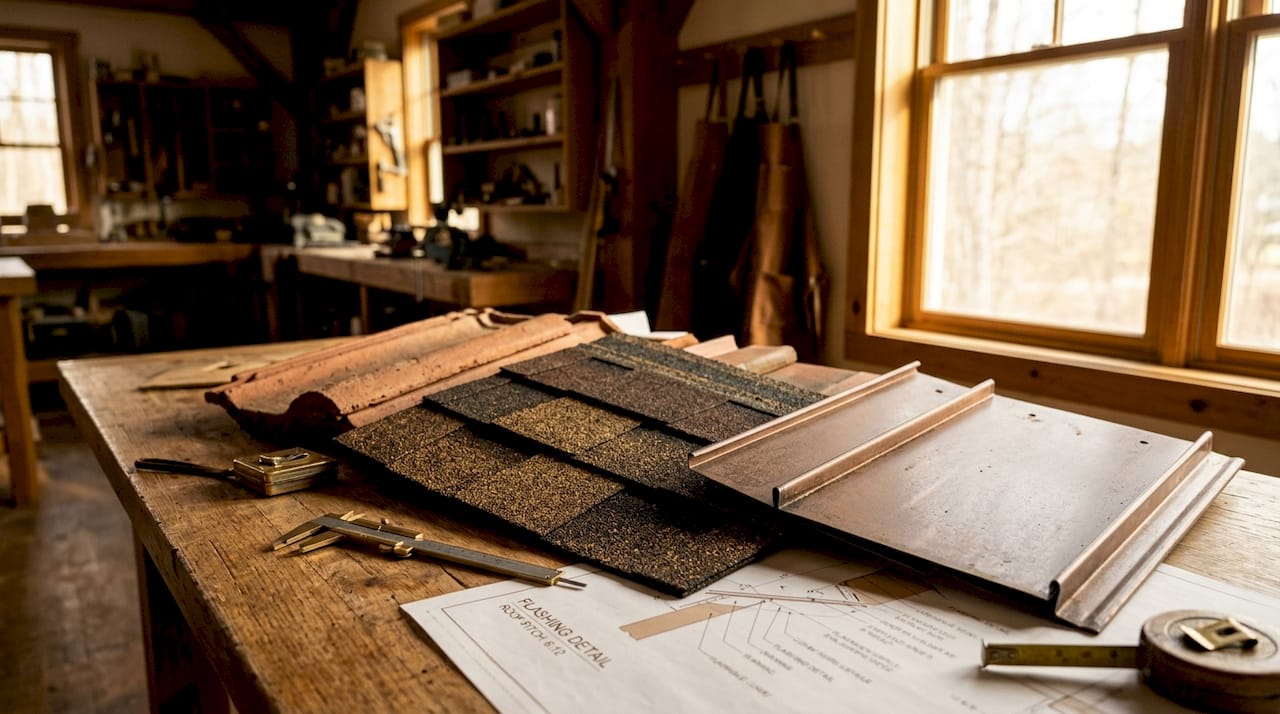
Common roofing materials compared
The table below shows how the most popular residential options stack up on the factors that define quality roofing.
| Material | Typical lifespan | Impact resistance | Key durability factor |
|---|---|---|---|
| Asphalt shingles (3-tab) | 15–20 years | Class 1–4 available | Granule retention, algae resistance |
| Architectural asphalt | 25–30 years | Class 3–4 available | Laminated layers, wind uplift rating |
| Metal (steel/aluminum) | 40–70 years | High | Corrosion-resistant coating, interlocking panels |
| Concrete/clay tile | 50+ years | Moderate | Color stability, freeze-thaw resistance |
| Slate | 75–100+ years | High | Natural density, minimal maintenance |
Impact resistance is the most critical rating for homeowners in hail-prone regions. The UL 2218 Class 4 rating is the highest available and requires a shingle to survive a 2-inch steel ball dropped from 20 feet without cracking or rupturing. That is a demanding test, and shingles that pass it hold up significantly better in real hailstorms than lower-rated products.
Beyond impact, granule retention matters for asphalt products because granules protect the underlying mat from UV degradation. Metal roofing depends on its factory-applied corrosion-resistant coating. Tile and slate rely on density and proper fastening to resist wind uplift. Each material has a specific failure mode, and quality products are engineered to address it directly.
Pro Tip: When shopping for asphalt shingles, ask for the manufacturer’s published wind speed rating alongside the UL 2218 class. A Class 4 shingle rated for 130 mph winds gives you two layers of documented protection.
Why installation quality and underlayment are essential to high-quality roofing
A premium shingle installed poorly will fail faster than a mid-grade shingle installed correctly. Impact resistance ratings combined with certified installation define a truly high-quality roofing system, because performance is system-wide, not shingle-deep. The two most overlooked installation components are underlayment and ice-and-water barriers.
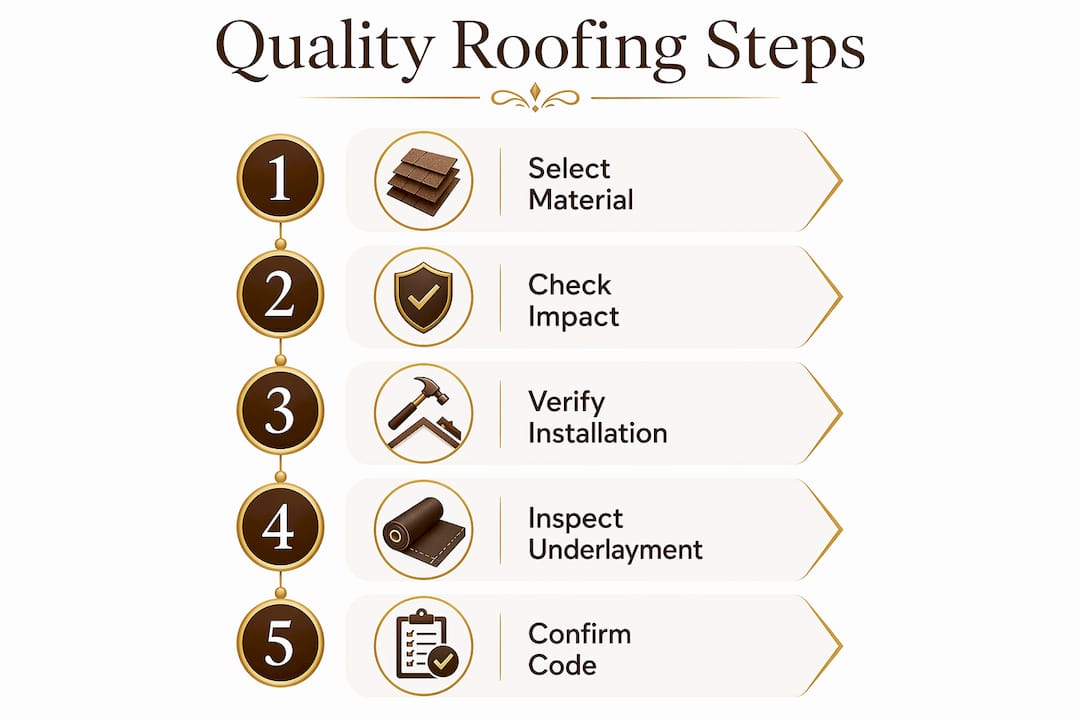
What underlayment actually does
Roof underlayment is legally required by the International Residential Code (IRC) 2021 as an integral part of the roof water-control system. It is not a backup layer or an optional upgrade. It protects the roof deck from wind-driven rain during a storm and from construction exposure before shingles are installed. Skipping it, or using a torn or improperly lapped product, voids most shingle warranties and violates code.
Homeowners often confuse general underlayment with ice-and-water shield. These are distinct products with different functions. General underlayment covers the full roof deck. Ice-and-water shield is a self-adhering waterproofing membrane applied only at vulnerable zones, including eaves, valleys, and roof penetrations like chimneys and skylights.
Here is how a properly sequenced installation should proceed:
- Inspect and prepare the deck. Any soft spots, rot, or missing sheathing must be replaced before any layer goes down.
- Apply ice-and-water shield at eaves. IRC 2024 requires this barrier at eaves regardless of climate, and in cold climates it must extend far enough up the slope to cover the area prone to ice dams.
- Install underlayment over the remaining deck. Low-slope roofs require two layers of underlayment per IRC 2024. Standard-slope roofs require one layer, lapped correctly.
- Flash all penetrations and valleys. Metal flashing at chimneys, vents, and wall intersections must be integrated with the underlayment, not just laid on top of it.
- Install shingles with the correct fastening pattern. Manufacturer specs define nail placement zones and nail count per shingle. Deviating from these specs voids the wind warranty.
Roof failures most often begin at eaves, valleys, and penetrations, not in the field of the roof. This is exactly why those zones receive extra waterproofing attention in both code and manufacturer guidelines.
Pro Tip: Before your contractor closes up the job, ask to see photos of the underlayment and ice barrier installation at the eaves and valleys. A quality contractor will have no hesitation sharing them.
How do performance ratings and building codes shape the definition of quality roofing?
Performance ratings and building codes are not bureaucratic formalities. They are the measurable standards that separate a quality roof from one that looks fine on day one but fails in year three.
The UL 2218 Class 4 designation signals structural impact resistance under fixed test conditions, but durability also depends on local hail characteristics and the age of the roof system. Class 4 is the benchmark to target in hail-prone areas like North Georgia, but it is a lab-tested performance benchmark, not a guarantee of hail immunity in every real-world scenario.
The IBHS FORTIFIED Roof designation takes quality assessment a step further by certifying the entire roof system. It requires a sealed deck, impact-rated coverings, and enhanced fastening patterns, all independently verified. Insurers in many states recognize FORTIFIED certification and offer premium discounts because the standard genuinely reduces claim frequency.
Key standards and code requirements that define quality roofing:
- UL 2218 Class 1 through 4: Impact resistance classes based on steel ball drop tests. Class 4 is the highest.
- IRC 2021/2024 underlayment mandates: Require specific underlayment types, lap dimensions, and ice-and-water barrier placement at vulnerable zones.
- Manufacturer installation guidelines: Nail patterns, fastener types, and overlap dimensions that must be followed to maintain warranty coverage.
- Local building permits: Permit inspections confirm code compliance at key stages of installation.
“A roof that passes inspection and meets manufacturer specs on day one is the minimum standard for quality. The real test is how it performs after five years of weather exposure.”
Pulling a permit for a roof replacement is not just a legal requirement. It creates a documented record that the work was inspected and approved, which matters when you file an insurance claim or sell the property.
What practical steps can homeowners take to select and ensure high-quality roofing?
Knowing the standards is useful. Knowing how to apply them when hiring a contractor and selecting materials is what actually protects your investment. Here is what to verify before and during any roofing project.
Before selecting materials:
- Check the UL 2218 impact class on the product data sheet, not just the marketing brochure.
- Review the manufacturer’s wind speed warranty. Look for ratings of 110 mph or higher for most regions.
- Ask about residential roofing material options that match your local climate hazards, whether that is hail, high winds, or freeze-thaw cycles.
- Confirm the product qualifies for any available insurance discount in your area, particularly if it carries a Class 4 or FORTIFIED designation.
When hiring a contractor:
- Verify the contractor is licensed and insured in your state. This is non-negotiable.
- Ask specifically whether they follow IRC 2024 underlayment requirements and manufacturer fastening specs.
- Request a written scope of work that lists the underlayment type, ice-and-water shield coverage areas, and flashing materials.
- Check that they will pull a permit and schedule an inspection. A contractor who discourages permits is a red flag.
During and after installation:
- Ask for photos of the underlayment and ice barrier before shingles go on.
- Inspect valleys, eaves, and penetrations yourself or hire an independent inspector.
- Keep all product data sheets, warranty documents, and the permit inspection record in a file. You will need them for insurance claims and resale.
For homeowners in storm-prone areas, understanding roof stormproofing features before selecting materials can help you prioritize the right upgrades from the start.
Pro Tip: Ask your contractor for the manufacturer’s installation manual for the specific shingle product being used. Compare the nail pattern in the manual to what the crew actually does on your roof. This one check catches the most common installation shortcuts.
Key takeaways
High-quality roofing requires both performance-rated materials and code-compliant installation working together as a complete system.
| Point | Details |
|---|---|
| Material ratings matter | Prioritize UL 2218 Class 4 impact resistance and published wind speed warranties when selecting shingles. |
| Underlayment is required by law | IRC 2021/2024 mandates underlayment as a core part of the roof assembly, not an optional add-on. |
| Vulnerable zones need extra protection | Eaves, valleys, and penetrations require ice-and-water shield and proper flashing to prevent the most common leak points. |
| Installation quality equals material quality | A premium shingle installed with the wrong nail pattern or missing underlayment will underperform a mid-grade product installed correctly. |
| Documentation protects your investment | Permits, inspection records, and warranty documents are proof of quality that matter for insurance claims and property resale. |
Why installation is the part most homeowners underestimate
I have seen a lot of roofs in North Georgia, and the pattern is consistent. When a roof fails prematurely, the shingles are rarely the problem. The problem is almost always at a valley, an eave, or around a chimney where the underlayment was lapped wrong or the ice barrier was cut short. Homeowners spend weeks comparing shingle brands and almost no time asking about installation practices. That is the wrong priority order.
The licensed contractor you hire matters more than the brand of shingle on the truck. A contractor who follows IRC 2024 requirements, pulls permits, and photographs their underlayment work is giving you something no product data sheet can: accountability. That accountability is what turns a good material into a good roof.
Building codes have also gotten more specific over time, and that is a good thing. The shift from IRC 2021 to IRC 2024 tightened underlayment requirements in ways that directly reduce leak risk. Contractors who stay current with those changes are the ones worth hiring. Ask them directly what changed in the 2024 code and watch how they answer. You will learn a lot.
One more thing worth saying plainly: the roofing upgrades that add the most long-term value are almost never the most visible ones. Sealed decks, proper ice barriers, and correct fastening patterns do not show up in photos. They show up five years later when your neighbor is filing a leak claim and you are not.
— Dan
Get quality roofing you can count on from Ir-ga
At Ir-ga, we have been serving homeowners across North Georgia since 2018 with licensed, insured roofing services built on the standards described in this article. Every project we complete uses premium materials with documented impact ratings, full IRC-compliant underlayment installation, and proper permitting. Whether you need storm damage repair after a hail event or a full roof replacement with quality upgrades, our team handles the entire process, including insurance claim management, from start to finish. We offer same-day responses and instant online estimates so you are never left waiting. Reach out to Ir-ga today and get a roof that is built to last.
FAQ
What is the most important characteristic of quality roofing?
High-quality roofing depends equally on material performance ratings and installation quality. A Class 4 impact-resistant shingle installed without proper underlayment and flashing will still fail at vulnerable points like eaves and valleys.
What does UL 2218 Class 4 mean for a roof?
UL 2218 Class 4 is the highest impact resistance rating for roofing products, requiring a shingle to withstand a 2-inch steel ball dropped from 20 feet without cracking. It is a strong performance benchmark but not a guarantee against damage in every severe hail event.
Is roof underlayment really required by code?
Yes. The IRC 2021 and IRC 2024 both require underlayment as a mandatory part of the roof assembly. It is not optional, and skipping it violates code and typically voids the shingle manufacturer’s warranty.
How do I know if a roofing contractor is doing quality work?
Ask the contractor to show you the manufacturer’s installation manual, confirm they will pull a permit, and request photos of the underlayment and ice barrier before shingles are installed. Reviewing contractor qualities that matter can also help you ask the right questions before signing a contract.
What is the IBHS FORTIFIED Roof designation?
The IBHS FORTIFIED Roof designation certifies a roof as a complete system, requiring a sealed deck, impact-rated coverings, and enhanced fastening, all independently verified. Many insurers recognize this designation and offer premium discounts because it measurably reduces storm-related claims.