Gutter maintenance is the practice of regularly cleaning, inspecting, and repairing your home’s drainage system to prevent water from damaging your foundation, fascia, walls, and interior. The importance of gutter maintenance becomes clear fast when you consider that a single inch of rainfall on a 2,000-square-foot roof generates roughly 1,250 gallons of water that needs somewhere to go. When gutters fail, that water goes somewhere it shouldn’t. Foundation cracks, rotted fascia boards, flooded basements, and mold growth are all direct results of gutters that were ignored too long. The good news is that routine upkeep costs a fraction of what repairs do.
What financial risks does gutter neglect pose?
Skipping gutter maintenance is one of the most expensive decisions a homeowner can make. Foundation and fascia damage from water overflow averages $8,000 in remediation costs, and basement flooding remediation runs between $4,500 and $7,500. Those numbers represent real repair bills that North Georgia homeowners face every year after a wet season.
Compare that to what prevention actually costs:
- Professional gutter cleaning for a standard single-story home runs $119 to $234, rarely exceeding $400 for larger properties.
- Fascia board replacement alone costs $500 to $4,000 depending on how far rot has spread.
- Basement waterproofing after flooding can reach $7,500 or more, not counting damaged belongings or flooring.
The math is straightforward. Spending $200 twice a year is far cheaper than a $6,000 foundation repair.
There is also an insurance angle that most homeowners overlook. Insurers may deny water damage claims if evidence points to long-term gutter neglect, such as clogged downspouts or visibly sagging gutters. That means a $15,000 water damage event could land entirely on your shoulders if your insurer documents that the cause was preventable. Routine cleaning creates a paper trail of responsible upkeep that protects your claim.
How does proper gutter care extend your home’s lifespan?
Gutters are not passive fixtures. They are precision drainage systems that require correct pitch, clear channels, and periodic inspection to do their job. Properly maintained gutters last 20 to 50 years depending on material, while neglected systems fail well before their time.

Here is how common gutter materials compare in lifespan under good maintenance conditions:
| Material | Expected lifespan | Key maintenance note |
|---|---|---|
| Copper | Up to 100 years | Minimal corrosion; inspect joints annually |
| Aluminum | 20 to 30 years | Prone to denting; check for pitch issues |
| Galvanized steel | 20 to 25 years | Watch for rust at seams |
| Vinyl | About 10 years | UV and freeze damage shorten life quickly |
Vinyl gutters in particular suffer fast when maintenance is skipped. Cold climates accelerate the problem because clogged gutters create ice dams that force water under roofing materials, causing structural damage that spreads well beyond the gutter line. Standing water in a blocked gutter also acts as a thermal bridge, accelerating wood rot in fascia boards within as little as 24 months.
Soil saturation is another underappreciated risk. When gutters overflow consistently, water pools at the base of your home. That saturated soil creates hydrostatic pressure against basement walls, leading to cracks and eventual flooding. Downspouts should discharge water at least 4 to 6 feet from the foundation to prevent this entirely.
Gutter guards reduce how often you need to clean, but they do not eliminate the need for inspection. Micro-mesh guards still accumulate fine debris like pollen, shingle grit, and seed particles over time. Even with guards installed, annual inspection remains necessary to catch partial blockages before they cause overflow.
Pro Tip: After installing gutter guards, run a garden hose through the system once a year to confirm water flows freely through every downspout. A slow drain means debris has built up inside, even if the surface looks clean.
What is the recommended gutter maintenance schedule?
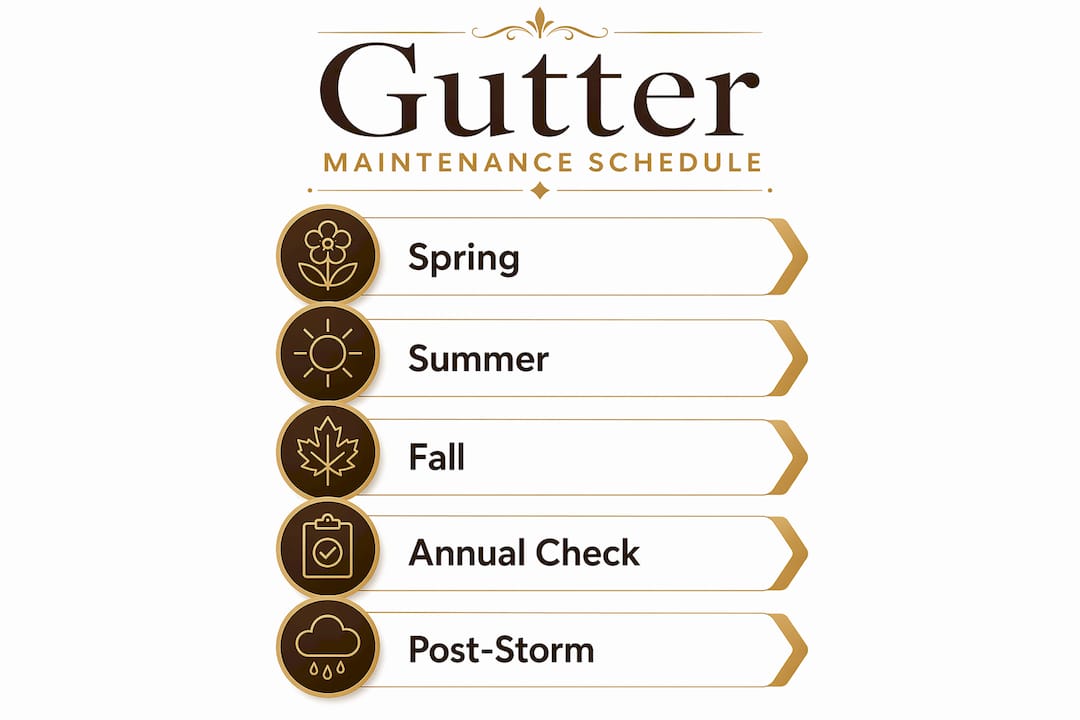
A consistent schedule is the core of any effective gutter upkeep plan. Most homes need cleaning twice a year, but the specifics depend on your property’s tree coverage and local climate. Here is a practical framework:
- Spring cleaning (March to April). Clear debris that accumulated over winter. Check for damage caused by ice, freeze-thaw cycles, or storm debris. Inspect all downspout connections and confirm proper pitch toward downspouts.
- Fall cleaning (October to November). This is the most critical cleaning of the year. Clear leaves before the first hard freeze to prevent ice dams and standing water. A blocked gutter heading into winter is a structural risk.
- Quarterly cleaning for heavy tree coverage. Homes surrounded by pine trees, oaks, or other high-debris trees need cleaning every three months. Pine needles in particular compact into dense mats that block water flow faster than leaf debris.
- Post-storm inspection. After any significant storm, check gutters for displaced sections, sagging, or debris accumulation. North Georgia’s storm season can deposit large volumes of debris in a single event. Our guide on storm-related roof and gutter repairs walks through what to look for after severe weather.
- Downspout extension check. Confirm that downspouts discharge water at least 4 to 6 feet from your foundation at every cleaning. Extensions shift over time and may need repositioning.
Pro Tip: Schedule your fall gutter cleaning for late November rather than early October. Cleaning too early means a second wave of leaves will refill the gutters before winter. One thorough late-season cleaning beats two rushed ones.
For homeowners in the Dallas, GA area and across North Georgia, our gutter cleaning tips for North Georgia homes cover region-specific timing based on local tree species and rainfall patterns.
How to identify signs that gutters need urgent attention
Catching problems early is what separates a $200 cleaning bill from a $5,000 repair. These are the warning signs that your gutters need immediate service:
- Sagging or pulling away from the fascia. Gutters that sag have either accumulated too much weight from debris and standing water or have fasteners that have failed. Both situations require prompt repair.
- Watermarks or staining on exterior walls. Streaks running down siding below the gutter line indicate overflow that has been happening for multiple rain events.
- Pooling water near the foundation. Water collecting at the base of your home after rain is a direct sign that downspouts are blocked or misdirected.
- Overflowing gutters during rain. If you see water cascading over the sides of your gutters during a storm, the system is blocked. This is the most visible and urgent warning sign.
- Fascia rot or soft wood behind the gutter. Press on the fascia board behind your gutters. Soft or spongy wood means moisture has been sitting against it long enough to cause rot.
- Pest activity near gutters. Mosquitoes breed in standing water. Birds, wasps, and rodents nest in debris-filled gutters. Unusual pest activity around your roofline often traces back to a clogged gutter system.
Any one of these signs warrants a same-day inspection. Multiple signs together mean damage may already be progressing. The financial and structural consequences of waiting compound quickly once water finds a path into your home’s structure.
Key takeaways
Gutter maintenance prevents thousands of dollars in avoidable repairs by keeping water away from your foundation, fascia, and interior walls.
| Point | Details |
|---|---|
| Neglect costs far more than cleaning | Foundation and basement repairs average $4,500 to $8,000 versus $119 to $234 for professional cleaning. |
| Material choice affects maintenance frequency | Copper gutters last up to 100 years; vinyl gutters may fail by year 10 without consistent care. |
| Twice-yearly cleaning is the baseline | Clean in spring and fall at minimum, quarterly if you have heavy tree coverage near your home. |
| Gutter guards reduce but don’t replace maintenance | Even micro-mesh guards need annual inspection and flushing to prevent fine debris buildup. |
| Insurance claims can be denied for neglect | Documented gutter neglect gives insurers grounds to reject water damage claims, leaving you fully liable. |
Why gutters deserve more respect than they get
Here is something I have seen repeatedly working with homeowners across North Georgia: gutters are the most ignored system on a house until they cause a catastrophe. People replace roofs, repaint siding, and upgrade HVAC systems on schedule. But gutters? They get cleaned when someone notices a problem, which is usually after the problem has already done damage.
The mindset shift that changes everything is treating your gutter system the way you treat your car’s oil. You do not wait for the engine to knock before changing it. You follow a schedule because prevention is cheaper than repair. A $150 cleaning twice a year is the equivalent of an oil change for your home’s drainage system.
What I find most telling is the insurance angle. Routine gutter cleaning is one of the few home maintenance tasks that directly protects your ability to file a successful water damage claim. Insurers look for evidence of neglect when a claim comes in. Clean gutters, documented service history, and properly functioning downspouts tell a very different story than sagging, debris-filled channels overflowing onto your foundation.
For multi-story homes, I always recommend hiring a licensed, insured contractor rather than attempting it yourself. Two-story gutter cleaning typically costs $100 to $275 and includes professionals with proper equipment and safety training. That cost is trivial compared to a fall injury or a missed blockage that causes interior water damage.
The highest-return home maintenance expense is not a new roof or fresh paint. It is the $200 you spend twice a year keeping water moving where it belongs.
— Dan
Protect your home with professional gutter services
Your gutters work hard every time it rains, and they need professional attention to keep performing. At Ir-ga, we provide licensed, insured gutter cleaning and repair services across North Georgia, including cleaning, full repairs, and guard installation. Our team handles everything from routine seasonal cleanings to urgent repairs after storm damage.

If your gutters are showing any of the warning signs covered in this article, do not wait for the damage to spread. We offer same-day responses and honest, fair pricing with no surprises. For homes that have already experienced storm-related gutter damage, our storm damage repair team can assess the full scope and work directly with your insurance provider. Reach out today and protect your home before the next rain event.
FAQ
How often should gutters be cleaned?
Most homes need gutter cleaning twice a year, in spring and fall. Homes with heavy tree coverage require quarterly cleaning to prevent debris buildup from blocking water flow.
What happens if you never clean your gutters?
Clogged gutters overflow and direct water against your fascia, foundation, and basement walls. Over time, this causes wood rot, foundation cracks, basement flooding, and potential mold growth inside your home.
Do gutter guards eliminate the need for maintenance?
No. Gutter guards reduce cleaning frequency but do not replace it. Micro-mesh guards still accumulate fine debris like pollen and shingle grit, and annual inspection and flushing remain necessary.
Can insurance deny a claim because of dirty gutters?
Yes. Insurers can deny water damage claims if evidence shows the damage resulted from long-term gutter neglect, such as chronically clogged downspouts or visibly sagging gutters.
How much does professional gutter cleaning cost?
Professional cleaning for a single-story home typically costs $119 to $234. Two-story homes run $100 to $275 depending on size and access, with most jobs rarely exceeding $400.